
Common Defects and Solutions of Tungsten Needle
Common defects and solutions of tungsten needle are critical for ensuring stable performance in demanding applications. As a tungsten needle manufacturer, CTIA has found through long-term production and application support that, despite its high melting point (~3410°C) and stable electrical conductivity, tungsten needle may still exhibit typical defects under conditions such as TIG (Tungsten Inert Gas) welding, plasma discharge, and precision electronic processing. These defects are mainly caused by high temperature, arc impact, and atmospheric fluctuations.
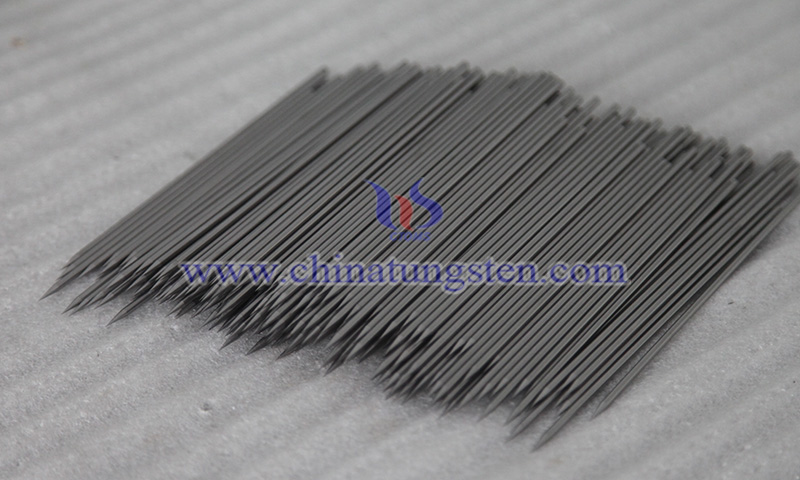
Performance stability depends not only on material quality, but also on manufacturing processes and operating conditions. The following summarizes common defects and corresponding solutions based on CTIA’s production experience and application data.
1. Common Defect TypesCTIA has summarized the common issues with tungsten needles into the following categories. These problems directly affect arc stability and service life.
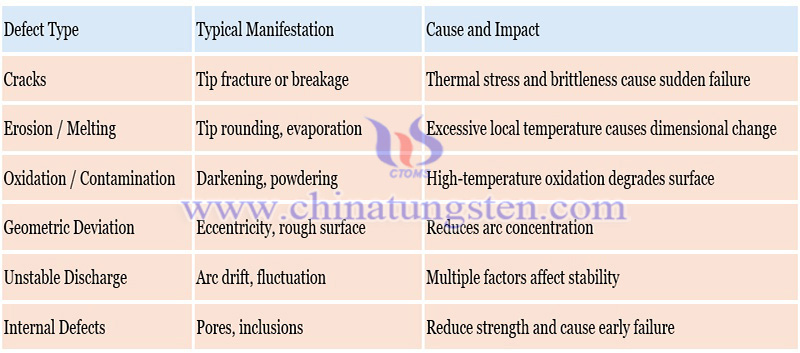
Cracking is a primary failure mode, especially under high load or frequent start-stop conditions. Tungsten exhibits a Ductile-to-Brittle Transition (DBT) at 200–500°C. Rapid heating or cooling generates thermal stress, and defects such as coarse grains or pores act as crack initiation sites.
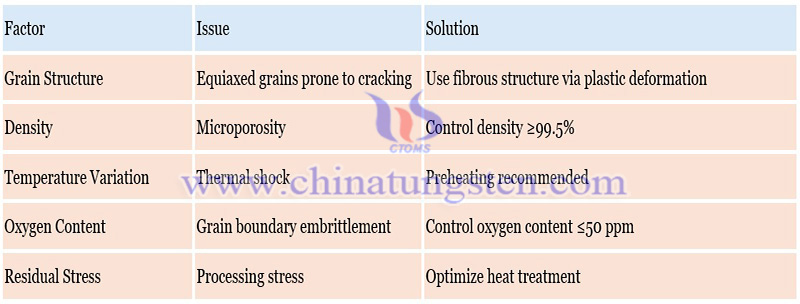
Tip erosion is a key factor affecting service life, especially under high current or continuous operation. Local temperature at the arc zone may approach or exceed the melting point, causing melting, evaporation, and resolidification.
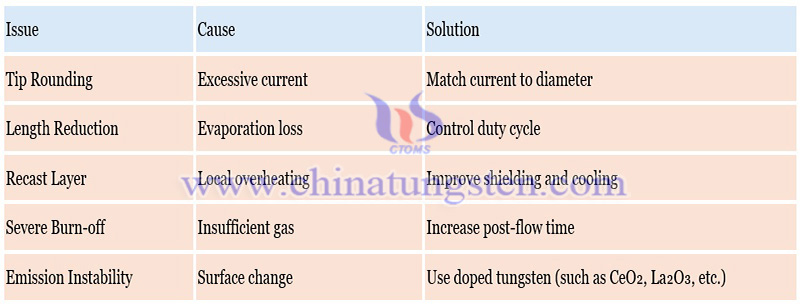
At high temperature, tungsten reacts with oxygen to form WO₃ (Tungsten Trioxide), which is volatile and degrades the surface. This is more severe with insufficient shielding gas purity.
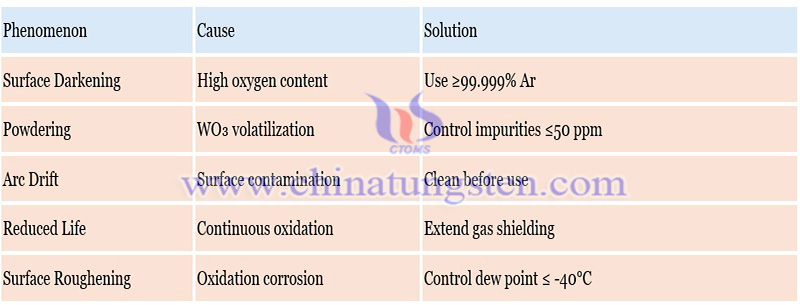
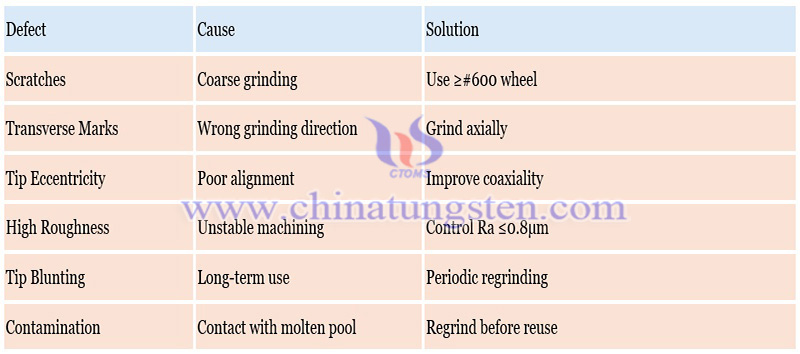
Some instability issues are caused by improper grinding or clamping rather than material defects. Tip geometry directly affects electron emission and arc behavior.
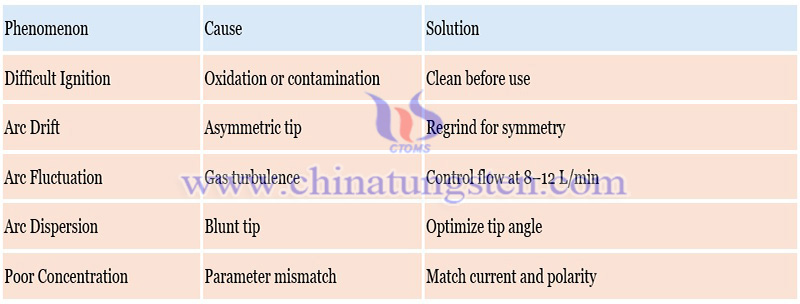
Unstable discharge is usually caused by combined effects of material condition, geometry, and operating parameters.
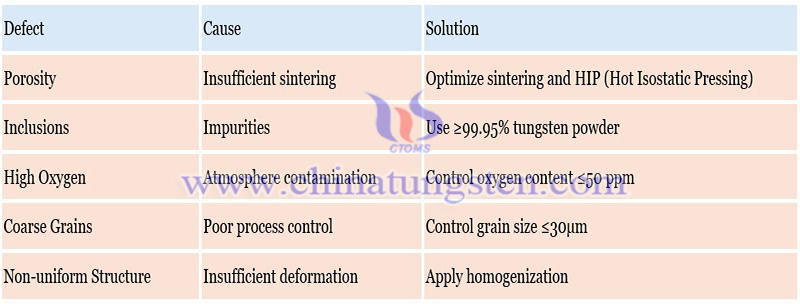
Internal defects such as pores, inclusions, and high oxygen content significantly affect service life and may expand rapidly under high-temperature conditions.
CTIA concludes that tungsten needle defects result from the combined effects of material brittleness, high-temperature arc conditions, and environmental factors. Effective control requires a systematic approach covering material selection, manufacturing processes, and application conditions.
High-purity, fine-grained, and properly doped tungsten improves crack resistance and emission stability. Optimized processing ensures structural uniformity and precision, while proper operating parameters and maintenance reduce performance fluctuations. Coordinated control of cracking, erosion, oxidation, and geometry significantly enhances discharge stability and service life.
For any inquiry, please contact tungsten needle manufacturer: CTIA GROUP
Email: sales@chinatungsten.com
Tel: 0086 592 5129696 / 0086 592 5129595
Website: www.tungsten.com.cn
WeChat:

More info>>