
CTIA Tungsten Needle in Arc Welding
CTIA tungsten needle in arc welding refers to tungsten electrode used in high-temperature arc processes. In the welding industry, tungsten needle is a colloquial term for tungsten electrodes, mainly used in TIG (Tungsten Inert Gas) welding, PAW (Plasma Arc Welding), and various arc discharge processes. Tungsten needle functions to maintain stable electron emission and arc integrity. Based on long-term collaboration with equipment manufacturers and end-users, CTIA has developed a systematic understanding of electrode failure mechanisms and performance variations under diverse arc welding conditions.
Arc welding is a high-energy-density process, with arc column temperatures ranging from 6,000–20,000 K, local current densities exceeding 10⁶ A/m², and exposure to electron emission, ion bombardment, and intense thermal radiation. Any electrode melting, volatilization, or tip geometry change can rapidly alter arc shape, causing diffusion, drift, or instability.
Tungsten’s adoption is due to its intrinsic properties: melting point ~3,410°C, elastic modulus ~400 GPa, resistivity ~5.6×10⁻⁸ Ω·m, work function ~4.5 eV, and vapor pressure below 10⁻⁷ Pa at 2,500 K. Combined with CTIA’s strict control of purity and microstructure uniformity, high-temperature erosion is minimized, enhancing tip stability under operational conditions.
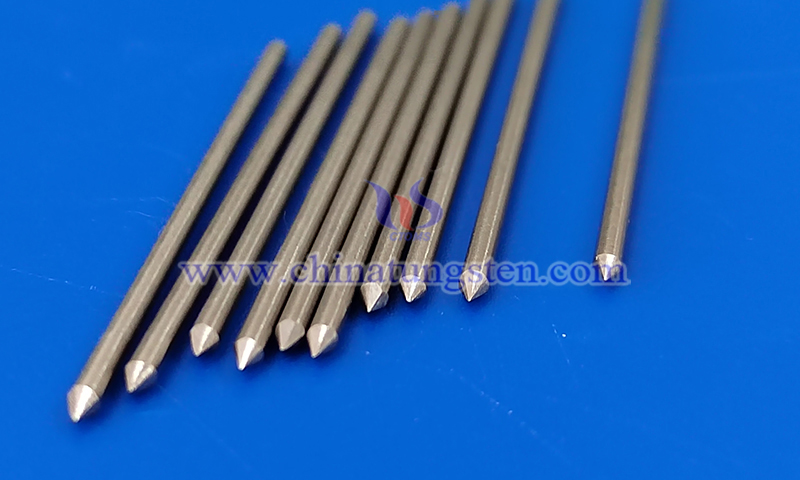
In Tungsten Inert Gas (TIG) Welding, arc stability directly affects weld formation and operational continuity. Currents of 20–150 A make the electrode tip critical to arc convergence. CTIA observed that arc divergence over time often results from tip passivation or localized melting. By controlling grain size and tip forming precision, tip angle and surface state are maintained, reducing morphology changes. Tungsten’s high melting point and low vapor pressure allow slow erosion, keeping a stable discharge point, especially in stainless steel, aluminum, and titanium alloy welding.
2. CTIA Tungsten Needle for PAW (Plasma Arc Welding)In Plasma Arc Welding (PAW), the arc forms a high-energy-density plasma jet, demanding superior thermal stability and erosion resistance. Tip morphology changes can reduce arc concentration and cause instability. Microstructural inconsistencies, such as porosity, accelerate localized erosion. CTIA optimizes sintering density and thermal processing to improve uniformity and erosion resistance. Tungsten’s low evaporation rate at 2,000–3,000 K preserves tip geometry, maintaining focused, stable arcs.
3. CTIA Tungsten Needle for Micro-WeldingMicro-welding currents range from mA to tens of A, and arc fluctuations impact weld size and connection quality. Electrodes require stable discharge and micron-scale geometric consistency. CTIA tungsten needles achieve micron-level dimensional control and consistent tip morphology. Tungsten’s high elastic modulus (~400 GPa) ensures rigidity at fine scales, minimizing bending or collapse. Stable electron emission and low wear rates enable continuous micro-welding with high repeatability.
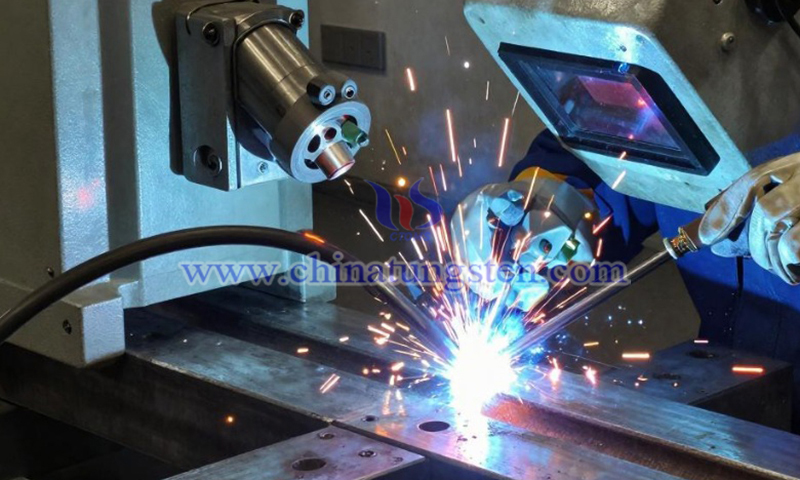
Precision welding emphasizes result consistency and inter-batch uniformity. Factors affecting arc stability include impurity content, grain uniformity, and processing consistency. Tungsten’s low thermal expansion and stable conductivity (~28–31% IACS) reduce dimensional changes during thermal cycling. Improved arc stability enhances weld quality and process repeatability, a key consideration in electrode selection.
5. CTIA Tungsten Needle for Automated WeldingAutomated welding demands long electrode life and operational stability. Minor performance variations affect production rhythm and equipment reliability. Electrodes endure prolonged high temperatures and repeated thermal cycles. CTIA controls material purity and microstructure to minimize high-temperature evaporation and localized erosion. Dense, uniform structure reduces thermal fatigue cracking, maintaining stable performance and process parameters for extended operation.
6. CTIA Tungsten Needle for Arc DischargeIn ignition and arc discharge, electrodes must rapidly establish stable discharges under high voltage while withstanding frequent thermal shocks. Insufficient initial electron emission can cause ignition delays or unstable arcs. CTIA optimizes tip geometry and surface condition to improve initial electron emission. Tungsten’s stable work function (~4.5 eV), high melting point, and erosion resistance ensure minimal material loss and consistent system stability.
Across arc welding scenarios, tungsten needle performance is determined by the combination of high melting point, low vapor pressure, stable electron emission, and mechanical rigidity. CTIA tungsten needles offer consistent, predictable behavior during prolonged use, which is why they remain a preferred choice in arc welding applications.
For any inquiry, please contact tungsten needle manufacturer: CTIA GROUP
Email: sales@chinatungsten.com
Tel: 0086 592 5129696 / 0086 592 5129595
Website: www.tungsten.com.cn
WeChat:

More info>>