
Manufacturing Process of Tungsten Needle
CTIA tungsten needle is manufactured based on powder metallurgy and precision plastic processing technologies, covering the complete process from raw material control to tip forming. Tungsten, with a high melting point of 3422°C, density of 19.25 g/cm³, elastic modulus of about 410 GPa, and excellent arc erosion resistance, is a key material in advanced electron emission and micro/nano probing fields. Typical applications include Scanning Tunneling Microscopy (STM) probes, Scanning Probe Microscopy (SPM) probes, Field Emission Electron Source (FEES) cathodes, and Liquid Metal Ion Source (LMIS) emitters.
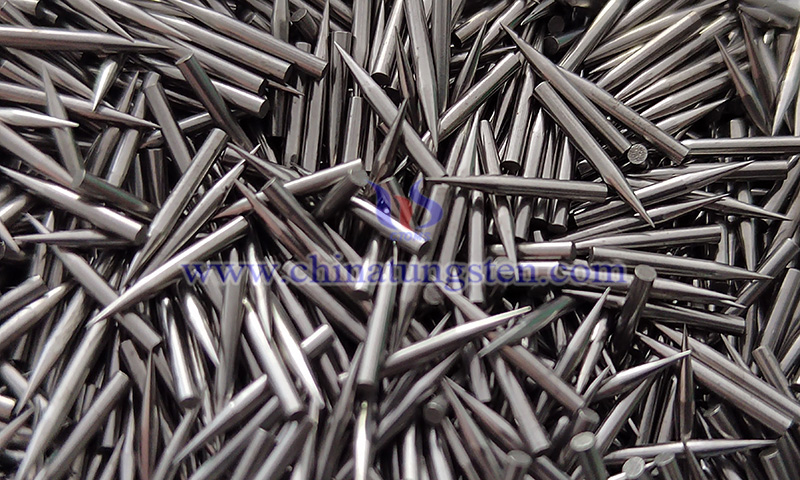
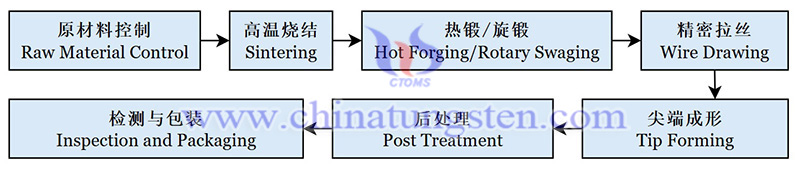
High-purity tungsten powder (≥99.95%) is used, with oxygen ≤300 ppm, carbon ≤200 ppm, and particle size of 1–5 μm. Uniformity is ensured through particle size and O/N analysis. Forming methods include CIP (Cold Isostatic Pressing) for dense billets and MIM (Metal Injection Molding) for complex microstructures.
2. Sintering DensificationSintering is carried out in hydrogen or high vacuum at 1800–2200°C for 4–8 hours. Diffusion mechanisms enable pore closure, achieving 98%–99.5% theoretical density. Hydrogen dew point ≤-40°C minimizes oxidation. The resulting equiaxed grain structure supports further processing.
3. Hot WorkingHot forging and rotary swaging at 1200–1600°C with over 60% deformation refine grains, improve strength and ductility, and reduce porosity. Tensile strength can exceed 1000 MPa.
4. Wire DrawingMulti-pass drawing with 15%–25% reduction per pass is applied, combined with intermediate annealing (800–1100°C) to relieve work hardening. Final diameters reach 0.05–1.0 mm with tolerance up to ±0.002 mm.
5. Tip FormingThe tip geometry directly affects the electric field concentration factor and emission stability, making it a critical process.
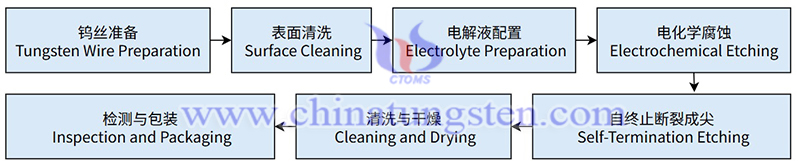
5.1 Electrochemical EtchingUnder 4–12 V DC in sodium hydroxide electrolyte, anodic dissolution enables self-sharpening. The apex radius can reach 0.3–0.7 μm, and the tip angle is typically controlled within 30°–90°. This method is suitable for Scanning Tunneling Microscopy (STM) and Scanning Probe Microscopy (SPM) probes. The electrochemical etching process flow for preparing tungsten needle is shown below:
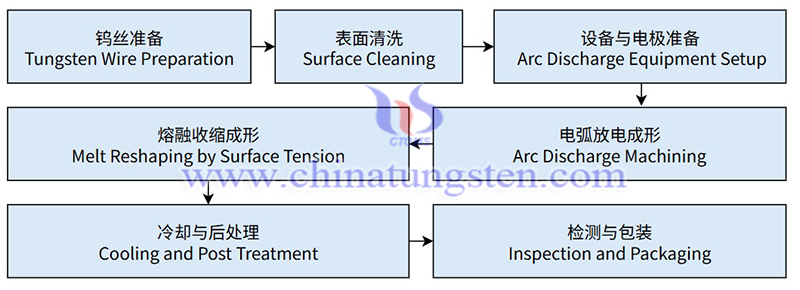
Instant arc discharge causes local melting, and surface tension forms a spherical tip. It is suitable for ball-tip probes and special emission structures. Arc discharge machining process flow for preparing tungsten needle is shown below:
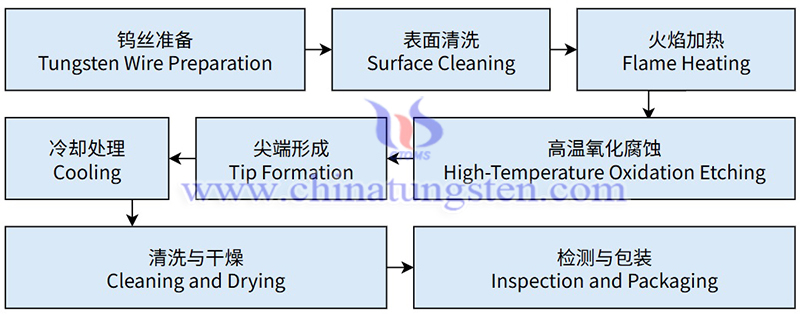
At approximately 2300 K, rapid oxidation and evaporation enable fast tip formation, suitable for batch production. Flame etching process flow for preparing tungsten needle is shown below:
Stress relief annealing improves stability. Ultrasonic and deionized water cleaning remove residues. High-end products undergo vacuum drying and clean packaging to prevent oxidation.
7. Inspection and PackagingInspection includes SEM tip morphology, surface roughness (Ra), mechanical properties, and field emission stability. Density ≥98% and apex radius tolerance within ±0.1 μm ensure stable performance.
Industrial needles are cleaned, dried, and packaged with anti-vibration protection, moisture-proof sealing, and reinforced outer packaging to prevent damage, contamination, and oxidation during transport.
Process flow chart of CTIA tungsten needle:
For any inquiry, please contact tungsten needle manufacturer: CTIA GROUP
Email: sales@chinatungsten.com
Tel: 0086 592 5129696 / 0086 592 5129595
Website: www.tungsten.com.cn
WeChat:

More info>>