
CTIA Tungsten Needle in Electronics and Precision Electronics
Tungsten needles play dual roles in electronics and precision electronics: providing highly stable electrical contact and micro-scale mechanical support. As electronic products evolve toward high-density packaging, miniaturization, and high reliability, contact dimensions shrink to micrometer or even sub-micrometer levels. Increasing contact frequency and current density place higher demands on material dimensional stability, electrical consistency, and wear resistance. With a high melting point (3422℃), high elastic modulus (~400 GPa), Vickers hardness (~350–500 HV), and stable resistivity (~5.6×10⁻⁸ Ω·m), tungsten needles are well-suited for various precision electronic applications.
Compared to copper alloys or precious metal-coated materials, tungsten resists plastic deformation and surface flaking during repeated contacts, maintaining stable contact interfaces under high-frequency and high-cycle conditions. Leveraging CTIA’s experience in electronics, customers focus on contact consistency, wear rate, and failure behavior during long-term use. High-density, uniform tungsten needles help ensure reliable performance output.
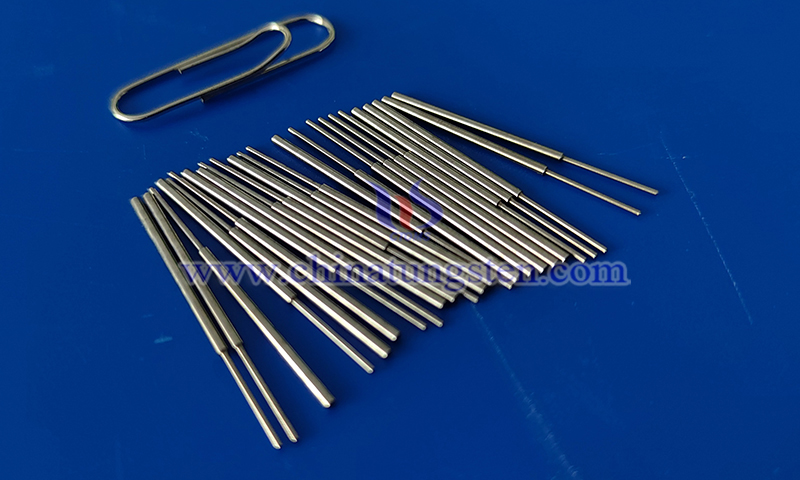
Electronic assembly involves component positioning, soldering assistance, and temporary conductive connections, requiring high contact precision and material stability. Tungsten needles are often used for micro solder pad positioning or current guidance, with contact state directly impacting assembly quality.
In electronic assembly, tungsten needles demonstrate excellent high-temperature stability and ablation resistance, resisting softening or shape changes under localized thermal input (>1000℃ instantaneous thermal shock). High hardness maintains tip geometry, ensuring positioning accuracy during assembly. CTIA controls tip dimensional tolerance and surface roughness to improve assembly consistency and reduce false contact risks.
2. Tungsten Needle for Precision ContactIn precision electronic devices, contact points continually shrink, demanding higher contact force and resistance stability. Tungsten needles serve as micro-contact conductors, enabling reliable electrical connections. High elastic modulus (~400 GPa) ensures stable deformation under micro-loads, avoiding poor contact or excessive indentation. Contact resistance changes minimally over repeated cycles, typically within milliohm range. CTIA optimizes material purity and structure to reduce interface fluctuations and enhance repeatability.
3. Tungsten Needle for Sensor ContactsSensors (pressure, temperature, displacement, etc.) rely on stable contact interfaces for accurate signal acquisition. Tungsten needles serve as high-stability contact materials in this context. Stable resistivity and low thermal expansion (~4.5×10⁻⁶/K) maintain contact performance across temperature changes. Oxidation resistance preserves surface condition, minimizing contact resistance drift. CTIA controls impurities and applies surface treatment to improve long-term stability.
4. Tungsten Needle for MEMS (Micro-Electro-Mechanical Systems) TestingMicro-Electro-Mechanical Systems (MEMS) feature micro-scale structures, demanding high probe dimensional precision and mechanical response. Tungsten needles provide stable contacts without damaging microstructures. High rigidity ensures good anti-bending performance at small scales, preventing structural deviation during contact. Tips can be fabricated to micron-level consistency to meet MEMS testing requirements. CTIA’s precision machining minimizes contact damage and improves test accuracy.
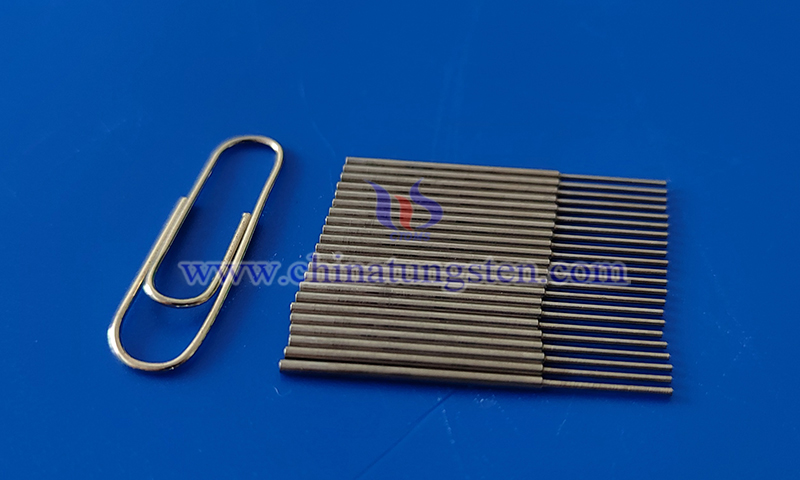
Accurate positioning is critical in microelectronics manufacturing and inspection. Tungsten needles function as conductive elements and micro-positioning tools. High hardness and dimensional stability prevent deformation during repeated positioning. Low thermal expansion maintains precision under temperature changes. CTIA manages internal stress and material uniformity to reduce long-term dimensional drift and improve positioning reliability.
6. Tungsten Needle for Microstructure AssemblyMicrostructure assembly involves handling and connecting micrometer- or nanometer-scale components, requiring rigid and stable tool materials. Tungsten needles provide stable support during micro-manipulation, resisting bending or breakage. Wear resistance maintains geometric precision over repeated operations. CTIA optimizes machining processes to enhance tip consistency, improving assembly efficiency and success rate.
7. Tungsten Needle for Nano-Device TestingNano-device testing involves extremely low currents (pA–nA) and very small contact areas, demanding high electrical stability and surface integrity. Tungsten needles provide low-noise, high-stability electrical contact. Tips can be fabricated to sub-micron dimensions while maintaining structural stability. Stable resistivity reduces signal noise, and dense structures minimize local electromigration risks. CTIA controls material purity and surface condition to enhance nano-scale test reliability.
8. Tungsten Needle for Connector TestingConnector testing includes insertion/removal cycles, contact resistance evaluation, and conduction performance assessment, requiring high wear resistance and contact consistency. Tungsten needles serve as high-frequency contact probes. High hardness reduces wear, maintaining stable contact geometry after extensive cycles (10⁵–10⁶). Minimal contact resistance variation improves test result consistency. CTIA optimizes material density and machining precision to reduce performance degradation during use.
Across electronics and precision electronics applications, the core advantages of tungsten needles arise from the synergy of high rigidity, stable conductivity, low wear, and excellent thermal stability. Coupled with CTIA’s ongoing expertise in high-purity control, uniform microstructure, and precision machining, these properties are consistently delivered under high-frequency, high-cycle, and micro-scale conditions. As electronic systems continue toward higher integration and smaller scales, demands for consistent and reliable contact materials will rise, expanding the depth and breadth of tungsten needle applications in precision electronics.
For any inquiry, please contact tungsten needle manufacturer: CTIA GROUP
Email: sales@chinatungsten.com
Tel: 0086 592 5129696 / 0086 592 5129595
Website: www.tungsten.com.cn
WeChat:

More info>>