
What Is Tungsten Needle?
Tungsten needle, or tungsten pin, is also commonly referred to as a tungsten electrode or tungsten probe needle. These different names correspond to its functional roles in welding, arc discharge, or precision testing. In essence, they all refer to needle-shaped functional components primarily made of tungsten.
CTIA tungsten needles are high-performance needle-shaped components manufactured from high-purity tungsten or tungsten-based alloys through precision forming and nanoscale machining processes. They integrate structural support, electrical conduction, and electron emission functions. Tungsten needles are widely used in electron microscopy, gas discharge systems, arc welding, semiconductor testing, and high-temperature vacuum environments, serving as critical fundamental components in advanced equipment systems.
From a material perspective, tungsten has a Body Centered Cubic (BCC) crystal structure, with a melting point of approximately 3422–3683°C, density of about 19.25 g/cm³, Young’s Modulus around 400 GPa, electrical resistivity of about 5.6 × 10⁻⁸ Ω·m, and a linear thermal expansion coefficient of approximately 4.5 × 10⁻⁶/K. It also exhibits low vapor pressure and excellent thermionic emission capability (Thermionic Emission). The high melting point and low thermal expansion coefficient ensure dimensional stability in high-temperature, high-vacuum, and strong electric field environments, while high modulus and hardness provide excellent resistance to bending and wear. Good electrical conductivity ensures stable arc formation and reliable current transmission.
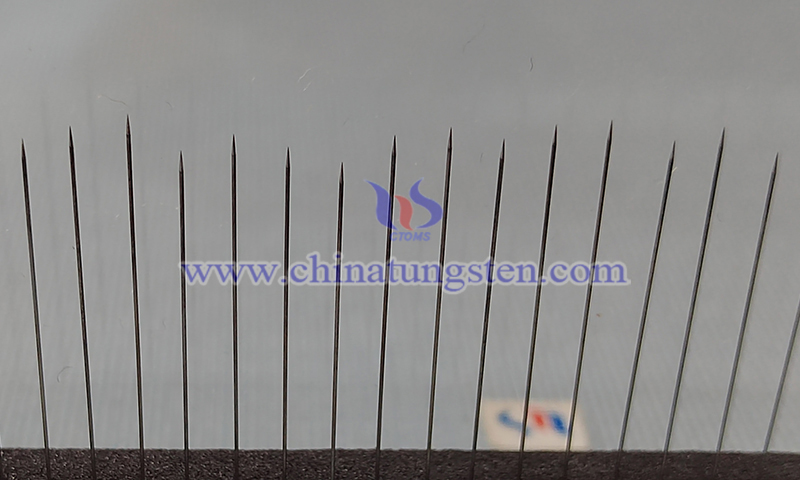
Based on the field emission effect (Field Emission), tungsten needles function as key cathode electron sources in Scanning Electron Microscopy (SEM) and Transmission Electron Microscopy (TEM), enabling high-brightness electron beam output and nanoscale resolution imaging.
CTIA tungsten needles can be classified into pure tungsten needles, rare-earth tungsten needles, and doped tungsten needles. Pure tungsten needles are manufactured from high-purity tungsten with a purity of ≥99.95%, providing high strength, good electrical conductivity, and excellent high-temperature stability. They are mainly used as electrodes in high-intensity gas discharge lamps and basic vacuum electronic devices. Rare-earth tungsten needles are produced through Powder Metallurgy by introducing 0.3%–5% rare-earth elements or oxides—such as CeO₂, La₂O₃, ZrO₂, Y₂O₃, and ThO₂—into the tungsten matrix. These additives form a dispersion-strengthened structure, significantly increasing the recrystallization temperature and reducing the work function (Work Function), thereby improving arc ignition performance and arc stability. Doped tungsten needles regulate electron emission behavior and grain growth resistance through low work-function oxides and represent an important development direction for replacing traditional radioactive thoriated tungsten electrodes.
In Tungsten Inert Gas Welding (TIG welding), the tungsten electrode is the core component responsible for generating the arc. In the welding industry, tungsten electrodes are often informally referred to as tungsten needles. However, “tungsten needle” is a colloquial industry expression rather than a strict academic or standard term. The formal standardized name remains tungsten electrode.
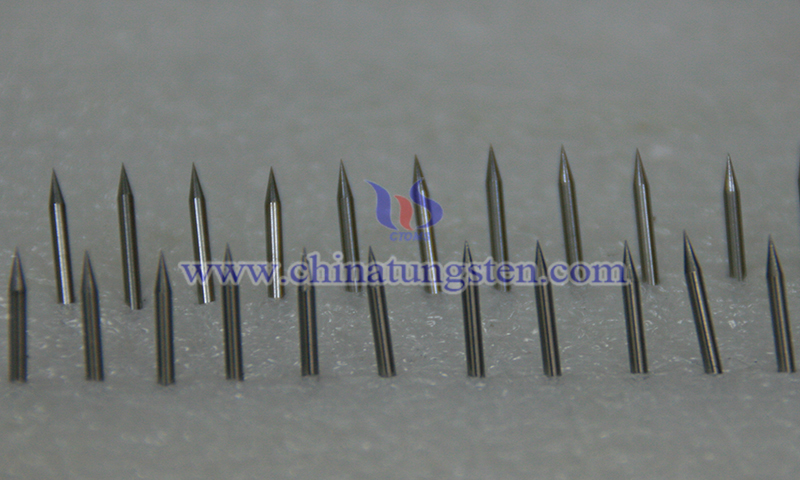
TIG welding tungsten needles commonly have diameters ranging from 0.25–6.4 mm and standard lengths from 75–600 mm, with typical diameters including 1.0 mm, 1.6 mm, 2.4 mm, and 3.2 mm. Under DC straight polarity (DCSP), the electrode is usually ground to a sharp point, and the tip angle is adjusted according to welding current and workpiece thickness. In AC (Alternating Current) welding, the electrode tip typically forms a hemispherical shape. The addition of rare-earth oxides improves arc column stability, reduces erosion rate, and extends service life. Electrode mass loss under high arc temperatures is referred to as erosion, including tungsten matrix erosion and oxide erosion, which can be effectively controlled by optimizing microstructure and oxide distribution.
CTIA manufactures tungsten needles using high-purity tungsten rods or tungsten wires through multi-stage cold drawing and precision diameter control to ensure tight dimensional tolerances. Electrochemical Polishing or Electrochemical Etching is applied to achieve nanoscale sharpening, allowing the needle tip radius to be controlled at approximately 50 nm and the tip angle (Tip Angle) between 10°–30°. Vacuum annealing is used to eliminate internal stress and optimize grain structure. For advanced research applications, ultra-fine finishing can also be performed using Focused Ion Beam (FIB) technology.
In addition to welding and discharge applications, tungsten needles are widely used in Scanning Probe Microscopy (SPM), Atomic Force Microscopy (AFM), nanomanipulation, nanoindentation, force spectroscopy, semiconductor wafer-level testing, probe card contact elements, high-voltage vacuum feedthrough electrodes, ion source emitters, mass spectrometry ionization electrodes, and precision microelectronic packaging welding.
Relying on capabilities in high-purity raw material preparation, powder metallurgy technology, and large-scale precision machining systems, CTIA GROUP continues to advance tungsten needle material systems and performance optimization, providing stable, reliable, and customizable high-performance tungsten needle solutions for electron microscopy, advanced welding, vacuum discharge, and semiconductor industries.
Tungsten needle is a needle-shaped tungsten electrode or probe used in welding, semiconductor testing, and high-temperature vacuum or discharge applications.
For any inquiry, please contact tungsten needle manufacturer: CTIA GROUP
Email: sales@chinatungsten.com
Tel: 0086 592 5129696 / 0086 592 5129595
Website: www.tungsten.com.cn
WeChat:

More info>>