
Tungsten Needle in Electrical Discharge Machining and Special Processing
Why can CTIA tungsten needles be applied in electrical discharge machining and special processing? In Electrical Discharge Machining (EDM) and various energy-field machining systems, material removal relies on transient plasma channels generated by pulsed discharges, with temperatures typically reaching 8000–12000 K, accompanied by localized melting, vaporization, and ejection. Discharge gaps are generally controlled between 1–50 μm, current density can reach 10⁶–10⁸ A/m², and single-pulse duration ranges from 1–100 μs. Under these extreme conditions, the electrode not only conducts current but also directly influences discharge stability, energy distribution, and machining accuracy.
CTIA emphasizes key properties in tungsten needles such as high melting point, low vapor pressure, stable resistivity, and erosion resistance. Tungsten features a melting point of ~3410 ℃, elastic modulus ~400 GPa, thermal conductivity ~170 W/(m·K), coefficient of thermal expansion ~4.5×10⁻⁶/K, resistivity ~5.6×10⁻⁸ Ω·m, and vapor pressure below 10⁻⁷ Pa at 2500 K. Using ≥99.95% high-purity raw materials and microstructure control, CTIA tungsten needles maintain stable tip morphology and electrical performance under high temperature, high current density, and microscale machining, meeting stringent requirements for electrode materials in EDM and special processing.
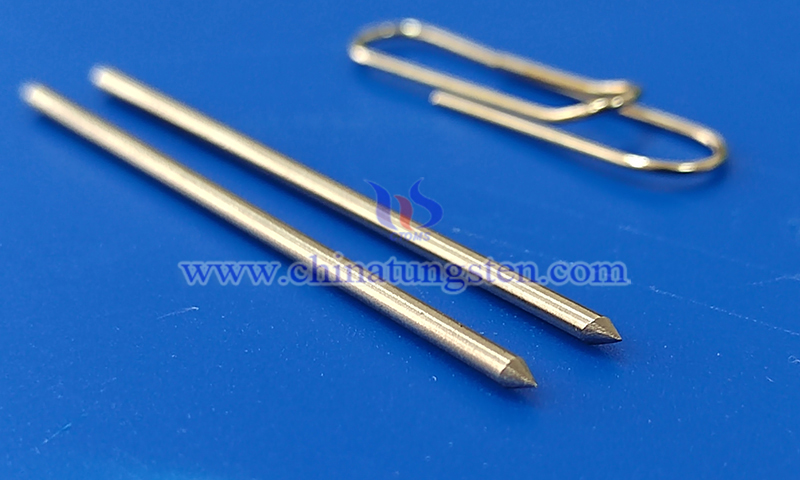
In Electrical Discharge Machining (EDM), electrodes must endure repeated thermal shocks under 20–120 V voltage and 1–100 A pulsed current. Extreme discharge temperatures can cause electrode melting and geometry degradation. CTIA tungsten needles’ high melting point and low vapor pressure prevent macroscopic collapse, effectively reducing Electrode Wear Rate (EWR).
Controlling material density and conductivity uniformity enables stable current transmission, ensuring uniform discharge channel distribution and minimizing abnormal discharges and short circuits. This significantly improves machining stability and surface integrity, suitable for high-precision mold cavities and complex structures.
2. CTIA Tungsten Needle for Micro Electrical Discharge Machining (Micro EDM)Micro Electrical Discharge Machining (Micro EDM) demands high electrode dimensional stability and rigidity, especially when diameters fall below 10 μm. Grain refinement and process optimization allow CTIA tungsten needles to retain high stiffness (~400 GPa elastic modulus), reducing machining vibration and deviation.
High recrystallization temperature (~1200–1400 ℃) and low vapor pressure suppress heat migration and tip blunting during high-frequency pulsed discharges. Combined with electrochemical etching and precision finishing, CTIA can produce tungsten needles suitable for high-precision microstructure machining.
3. CTIA Tungsten Needle for Fine Hole DrillingFor high aspect ratio micro-holes, electrodes must operate stably in confined spaces, resisting thermal deformation and lateral discharge effects. CTIA tungsten needles achieve 800–1000 MPa tensile strength and maintain straightness and rigidity in long, slender structures. Low thermal expansion (~4.5×10⁻⁶/K) minimizes dimensional drift during continuous discharge, ensuring hole diameter accuracy and wall consistency. Widely used in nozzle holes, cooling holes, and precision through-holes.
4. CTIA Tungsten Needle for Wire-EDM Pre-Hole PreparationDuring pre-hole drilling, hole quality and dimensional stability are critical. CTIA tungsten needles maintain tip geometry under short-duration discharges. Erosion resistance reduces hole mouth collapse and recast layer thickness. Optimized material purity and surface state create uniform discharge, reducing wall roughness, improving threading success, and enhancing subsequent wire-cutting efficiency. Suitable for high-precision molds and complex structures.
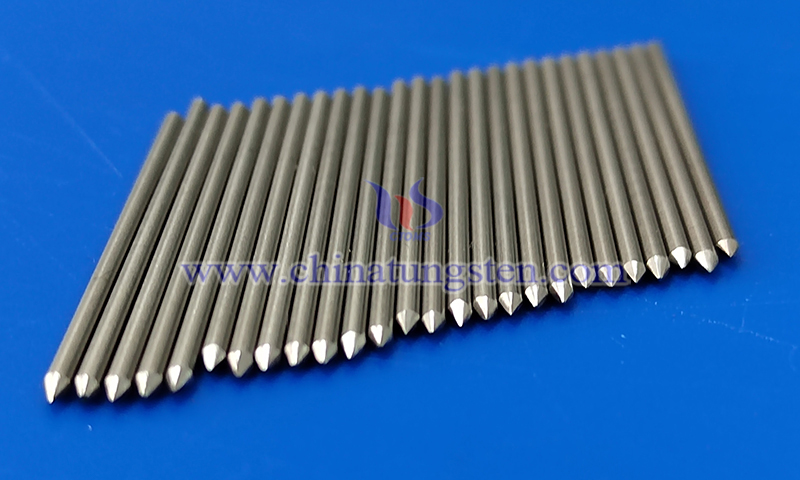
Micro-hole machining requires electrode dimensional consistency and discharge stability. CTIA controls diameter tolerance within ±1 μm and maintains axial alignment. Stable resistivity (~5.6×10⁻⁸ Ω·m) ensures uniform current distribution and steady discharge channels. Optimized parameters achieve hole diameter error <±2 μm, wall roughness Ra <1.0 μm, suitable for microfluidic structures, fuel injector holes, and precision filters.
6. CTIA Tungsten Needle for Micro-Mold MachiningMicro-mold machining demands high structural and boundary precision. Multi-step electrochemical etching and precision shaping enable nanoscale tip curvature control. High hardness (~350–500 HV) and wear resistance prevent tip wear or deformation during prolonged discharge. Stable electrical performance concentrates discharge energy, improving microstructure edge clarity and repeatability for high-end micro-mold manufacturing.
7. CTIA Tungsten Needle for Hard Material MachiningFor hard alloys and engineering ceramics, CTIA tungsten needles maintain stable morphology under high-energy discharge. Low vapor pressure and strong erosion resistance reduce electrode wear. Stable conductivity ensures uniform discharge, minimizing drift and local overheating. In materials like WC-Co or Al₂O₃, high material removal efficiency and low surface defects are achieved.
8. CTIA Tungsten Needle for Precision EngravingPrecision engraving requires highly stable electrode tip dimensions. CTIA tungsten needles achieve nanoscale curvature radii and retain geometry during repeated operations. High elastic modulus and wear resistance maintain tip consistency, while stable electrical performance ensures uniform discharge and precise energy control, delivering sharp boundaries and high-quality surfaces for complex microstructures and fine patterns.
Relying on high-purity raw material control, powder metallurgy densification, and precision shaping capabilities, CTIA achieves stable manufacturing of tungsten needles from the micrometer to nanometer scale. Tailored guidance is provided for different discharge parameters, including peak current, pulse width, and gap voltage. As high-end manufacturing increasingly demands miniaturization and ultra-precision, CTIA tungsten needles continue to deliver reliable and consistent material solutions for electrical discharge and specialized processing applications.
For any inquiry, please contact tungsten needle manufacturer: CTIA GROUP
Email: sales@chinatungsten.com
Tel: 0086 592 5129696 / 0086 592 5129595
Website: www.tungsten.com.cn
WeChat:

More info>>