
CTIA Tungsten Needle in Vacuum and High-Temperature Environments
CTIA tungsten needle serves as a critical functional component in vacuum and high-temperature environments, performing key roles in electron emission, beam control, micro-area modulation, and ion/electron acceleration. Under high vacuum (Vacuum Environment, VE) and elevated temperatures, the tip material must maintain thermal stability, mechanical strength, and structural integrity to ensure long-term reliable operation.
With a high melting point (~3410℃), high density (~19.3 g/cm³), low vapor pressure, and excellent thermal conductivity (~173 W/m·K), tungsten needle maintains tip geometry and electrical stability under accelerating voltage, micrometer-scale beam focusing, and continuous operation. CTIA achieves stable tip coaxiality, curvature radius, and microstructural uniformity through high-purity raw material control, grain refinement, and precision tip fabrication, providing reliable solutions for scientific research, industrial systems, and high-power electronic devices.
Tungsten needle used in vacuum electronic devices, electron emission sources, particle sources, plasma systems, and high-temperature electrodes requires extremely high standards in tip geometry, material purity, and structural uniformity. Tip size, curvature radius, surface roughness, and grain distribution directly influence field emission current density, beam stability, and service life. Through precision polishing, heat treatment, and surface cleaning processes, CTIA controls tip radius to tens of nanometers with surface defect rates below 0.5%, ensuring high brightness, low noise, and repeatable emission performance during long-term operation.
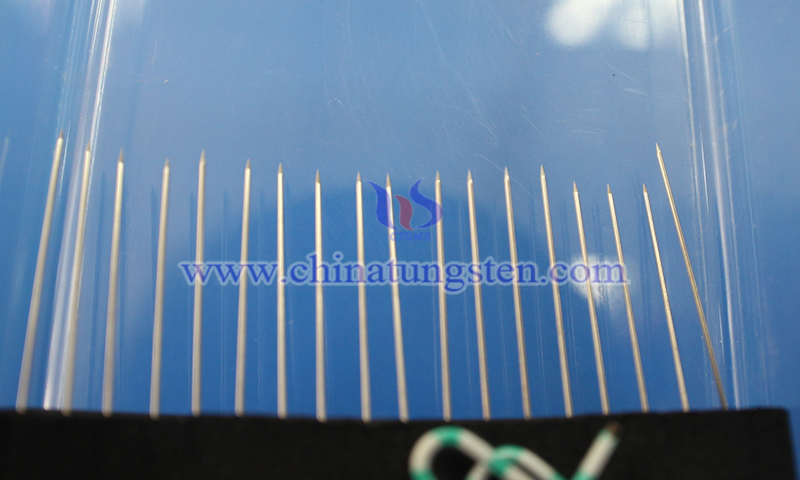
In vacuum electronic devices, tungsten needle functions as an electron beam emitter and modulator. Its high melting point, excellent thermal conductivity, and structural stability ensure consistent tip geometry and dimensional stability in high vacuum environments. Low vapor pressure minimizes material loss during long-term operation, maintaining emission efficiency and beam focusing accuracy. In applications such as electron tubes, microwave devices, vacuum switches, and magnetrons, optimized tip forming and grain structure enable beam symmetry, precise modulation, and reliable long-term operation.
Tip radius is typically controlled within 50–200 nm, with surface roughness (Ra) ≤5 nm, effectively reducing non-uniform emission and evaporation risks caused by local field enhancement. These parameters directly determine beam modulation accuracy, device lifetime, and reliability under high-power operation.
2. Tungsten Needle for Electron Emission SourcesIn electron emission sources, tungsten needle directly determines emission current density, beam uniformity, and stability. High mechanical strength (~400 GPa), elastic modulus, and thermal stability prevent deformation or ablation under strong electric fields and localized heating. CTIA precisely controls tip curvature, coaxiality, and grain distribution through high-purity materials, precision polishing, and heat treatment, reducing emission noise, improving beam stability, and extending service life.
Applications include particle accelerator injection systems, Field Emission Microscope (FEM), micro/nano fabrication equipment, and Scanning Electron Microscope (SEM) sources. The tip can withstand local current densities up to 10⁶–10⁷ A/cm², maintaining continuous emission and high brightness performance.
3. Tungsten Needle for Particle SourcesIn particle source applications, tungsten needle acts as the core emitter for ion or electron acceleration. Its high melting point, low vapor pressure, and mechanical strength ensure no tip deformation or local ablation under high voltage (tens to hundreds of kV) and strong beam currents (tens of μA to mA). It maintains beam directionality, energy uniformity, and low emission noise, meeting high-precision and reliability requirements in scientific and industrial applications.
In Liquid Metal Ion Source (LMIS), tungsten needle serves as the substrate supporting molten metals (such as gallium, indium, or alloys) to form a Taylor cone for stable ion emission. CTIA ensures micrometer- and nanometer-level precision in tip coaxiality and curvature through grain optimization and precision machining, enabling continuous, high-brightness, and repeatable ion beam output.
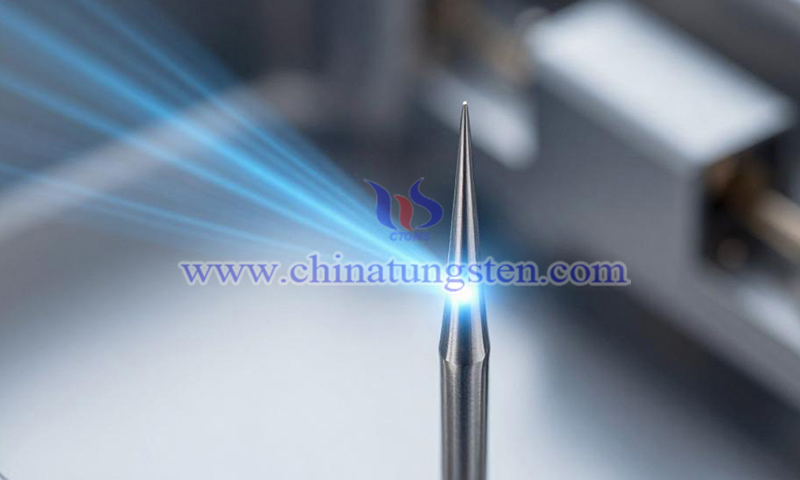
In plasma environments, tungsten needle is used for arc discharge, ion beam guidance, and high-energy beam modulation, where it must withstand localized high temperatures, strong currents, and ion bombardment. Its high melting point and low vapor pressure prevent melting or evaporation under arc conditions, while high strength and thermal conductivity dissipate heat rapidly, reducing local overheating risks and ensuring stable operation.
In plasma experimental systems, high-power microwave devices, discharge initiators, and arc power components, tungsten needle demonstrates excellent resistance to thermal shock and corrosion. CTIA maintains surface defect rates below 0.5% through precision tip processing and grain optimization, ensuring beam symmetry and repeatability while extending service life.
5. Tungsten Needle for High-Temperature Electrode (HTE)In high-temperature electrode applications, tungsten needle operates under temperatures ranging from hundreds to over a thousand degrees Celsius, requiring stable tip geometry, mechanical properties, and electrical consistency. Its high melting point, strength, and thermal stability ensure controlled tip radius, uniform grain structure, and stable coaxiality for long-term operation and uniform current distribution.
In vacuum melting, electron beam welding, induction heating, and high-power electronic devices, tungsten needle withstands local heat flux densities of 10–50 MW/m², with service life exceeding 1000 hours of continuous operation. CTIA further reduces stress concentration and thermal fatigue through heat treatment and surface optimization, improving durability and reusability.
Tungsten needle achieves long-term reliable emission under high vacuum, high electric field, and high-temperature conditions through its thermal stability, mechanical strength, low vapor pressure, and uniform grain structure. Stable tip geometry and material performance provide high precision, repeatability, and long-term reliability across vacuum electronic devices, emission sources, particle systems, plasma equipment, and high-temperature electrodes.
Its advantages extend beyond heat resistance and structural stability to include controllable tip dimensions, low surface defects, and uniform microstructure, making it an indispensable material in scientific research, micro/nano fabrication, high-power devices, and precision electronic systems. Through continuous optimization of materials, processes, and tip fabrication, CTIA provides stable and reliable tungsten needle solutions for advanced vacuum electronics and high-temperature power systems.
For any inquiry, please contact tungsten needle manufacturer: CTIA GROUP
Email: sales@chinatungsten.com
Tel: 0086 592 5129696 / 0086 592 5129595
Website: www.tungsten.com.cn
WeChat:

More info>>