
CTIA Tungsten Needle in Semiconductor Testing and Failure Analysis
Why can tungsten needles be applied in semiconductor testing and failure analysis? The answer lies in the strong alignment between material properties and advanced process requirements. As process nodes shrink to the nanometer scale, test contact windows become smaller, and current density and test frequency continue to rise, placing extremely high demands on probe mechanical stability, electrical consistency, and dimensional accuracy. Under high-frequency and high-cycle conditions, even minor variations in probe geometry or contact resistance can directly affect test accuracy and repeatability, so materials must deliver long-term, stable performance.
Tungsten needles, with high elastic modulus (~400 GPa), high hardness (~350–500 HV), high strength (≥1000 MPa), stable resistivity (~5.6×10⁻⁸ Ω·m), and ultra-high melting point (~3410℃), maintain stable performance under micro-contact and high-current conditions. Compared to copper alloy or coated probes, tungsten resists plastic deformation or surface degradation during repeated contacts, preserving stable contact resistance and geometry over high-cycle operation. By improving material density, uniformity, and impurity control, CTIA further enhances tungsten needles’ fatigue resistance and consistency, meeting the core reliability requirements of semiconductor testing and failure analysis.
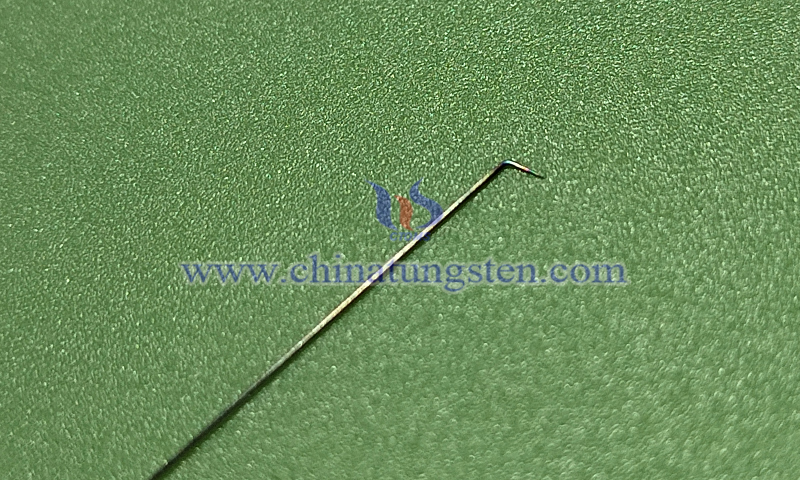
Probe cards are the core execution units in wafer-level testing, providing electrical connections between chip pads and test systems. In mass production, each probe may undergo over 10⁶ contact cycles while maintaining stable contact resistance and force.
In probe card systems, tungsten needles act as micro-contact conductive units, typically with diameters of 10–50 μm. The needle tip must form stable indentations without damaging aluminum or copper pads. High elastic modulus and resilience minimize plastic deformation, keeping contact force in a stable range (typically 0.5–2 gf). CTIA optimizes sintering density and grain uniformity to reduce internal defects and stress concentration, enhancing cycle life and limiting contact resistance drift.
2. Tungsten Needle for Nanoprobing SystemNanoprobing systems are primarily used for Failure Analysis (FA) of advanced process chips, including local circuit access, leakage path identification, and micro-area electrical characterization (I–V, C–V). Operating in Scanning Electron Microscopy (SEM) or Focused Ion Beam (FIB) environments, these systems demand extremely high probe size and positioning accuracy.
Tungsten needles for nanoprobing can be fabricated to sub-micron or even nanometer tip sizes (<1 μm) while maintaining high geometric consistency. High elastic modulus (~400 GPa) reduces contact drift caused by micro-vibrations, keeping positioning accuracy within nanometer range. CTIA controls tip roughness through precision machining and surface treatment to minimize contact noise and stabilize micro-current test signals.
3. Tungsten Needle for Wafer TestingWafer testing is a critical quality control step in semiconductor manufacturing, assessing electrical performance of each chip unit. Probes must maintain stable electrical connections under high-frequency contacts and current load.
Tungsten needles demonstrate high wear resistance and stable conductivity. With bulk resistivity of ~5.6×10⁻⁸ Ω·m and high hardness, tip wear is minimal over repeated contacts, maintaining stable contact area. CTIA ensures tip geometric consistency and material purity, keeping contact resistance typically between 20–50 mΩ and reducing data fluctuation.
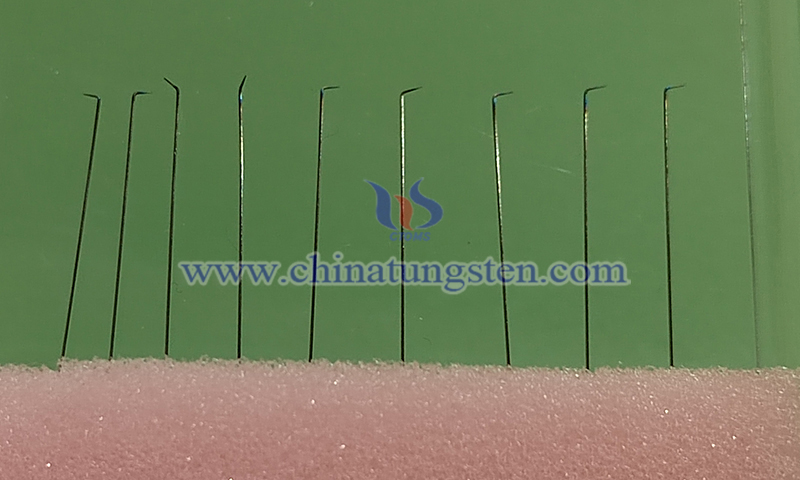
Failure analysis identifies internal chip defects such as opens, shorts, leakage, and structural damage. It involves local electrical tests and micro-area signal acquisition, demanding high dimensional stability and contact precision from probes.
Tungsten needles provide stable conductive paths within very small contact areas. High rigidity prevents tip deflection or collapse, and tungsten resists softening or structural changes under high temperature and local current stress. CTIA improves material purity and reduces impurities to lower electromigration and local hotspot risks, enhancing FA reliability.
5. Tungsten Needle for Electrical Parameter TestingElectrical parameter testing involves measuring current, voltage, impedance, capacitance, etc., requiring stable conductivity and consistent probe contact. Variations in contact resistance directly affect measurement accuracy.
Tungsten needles maintain consistent electrical performance through repeated cycles due to stable resistivity and low contact wear. Low thermal expansion (~4.5×10⁻⁶/K) minimizes contact position shifts due to temperature rise. CTIA controls impurities (e.g., O, C) at ppm levels to reduce electrical performance fluctuation and improve repeatability.
6. Tungsten Needle for Contact Resistance TestingContact resistance testing evaluates material or interface conductivity, requiring high probe stability and surface quality. Even small surface changes can cause measurement deviations.
Tungsten needles rely on high hardness and stable surface morphology to minimize plastic deformation and surface contamination during contact. Low wear ensures tips maintain stable contact area, reducing resistance fluctuation. CTIA controls tip roughness and geometric consistency to limit measurement error and enhance data reliability.
Across semiconductor testing and failure analysis applications, the value of tungsten needles lies not in a single property, but in the combination of high rigidity, stable conductivity, low wear, and excellent fatigue resistance. Leveraging CTIA’s experience in high-purity control, uniform microstructure, and precision machining, these properties are reliably delivered under high-frequency, high-cycle, and micro-contact conditions. As semiconductor technology continues toward smaller nodes and higher integration, consistent material performance becomes increasingly critical, reinforcing tungsten needles’ role as essential contact elements in advanced testing systems.
For any inquiry, please contact tungsten needle manufacturer: CTIA GROUP
Email: sales@chinatungsten.com
Tel: 0086 592 5129696 / 0086 592 5129595
Website: www.tungsten.com.cn
WeChat:

More info>>