
CTIA Tungsten Needle in Test Probes and Electronic Testing
CTIA tungsten needles play a critical role in test probes and electronic testing by providing stable electrical contact and high repeatable micro-contact performance. As semiconductor devices and electronic components become denser, faster, and smaller, the testing process demands probes with consistent conductivity, mechanical rigidity, and dimensional stability. Tungsten’s high melting point (~3422 °C), high elastic modulus (~400 GPa), stable conductivity (~28–31% IACS), low vapor pressure, and wear resistance make it highly suitable for diverse precision testing scenarios.
Compared with copper alloys or coated probes, tungsten resists plastic deformation under micro-contact and maintains consistent contact force and geometry over repeated load-unload cycles. Based on CTIA’s extensive experience in electronic testing applications, the key is not a single electrical parameter but ensuring long-term contact consistency, dimensional stability, and controlled failure behavior.
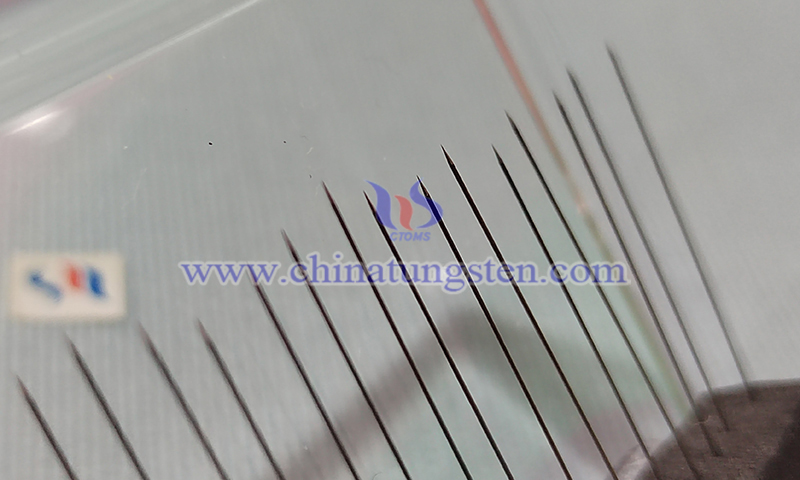
Four-point probe testing is widely used to measure the resistivity of semiconductor materials, thin conductive films, and coatings. Its core objective is to minimize the influence of contact resistance on measurement results. Test currents typically range from a few milliamperes to tens of milliamperes, demanding high probe contact stability. Tungsten needles serve as stable points for current injection and voltage sampling, with any change in the contact interface directly affecting measurement accuracy.
Tungsten needles demonstrate low wear rates and stable surface conditions during repeated contacts, keeping contact resistance fluctuations minimal. Their high hardness and elastic modulus help reduce contact indentation changes, maintaining consistent probe spacing. CTIA further controls tip radius and surface roughness (Ra ≤ 0.2 μm) to reduce contact variability and improve measurement repeatability.
2. CTIA Tungsten Needle for RF (Radio Frequency) TestingRadio Frequency (RF) Testing generally operates across MHz to GHz frequencies, requiring strict signal integrity, impedance matching, and contact stability. Micro-scale changes at the contact interface can cause localized impedance jumps, affecting reflection coefficients (S11) and transmission losses. Tungsten needles not only provide electrical conduction but also form part of the high-frequency signal path.
With stable conductivity (~28–31% IACS) and minimal morphology change, tungsten needles maintain consistent electrical properties even after repeated contacts. By optimizing tip geometry, CTIA reduces random contact resistance fluctuations, ensuring reliable signal transmission in high-frequency testing.
3. CTIA Tungsten Needle for High-Frequency TestingIn GHz and higher-frequency applications, the skin effect concentrates current at the conductor surface, making the material’s surface condition highly sensitive. Tungsten needle surface roughness, oxidation state, and micro-defects all influence signal loss.
Through precision machining and surface control, tungsten needles achieve low surface roughness, minimizing scattering losses. Tungsten resists surface flaking or coating degradation during repeated contact, offering long-term stability compared with coated probes. CTIA’s process control, including increased material density and uniform microstructure, further reduces signal fluctuation under high-frequency conditions.
4. CTIA Tungsten Needle for Micro-Contact TestingMicro-contact testing, commonly used in chip-level and microelectronic package inspections, operates at micrometer or sub-micrometer scales, demanding high geometric precision and mechanical performance. Tungsten needles provide stable conduction over extremely small contact areas while maintaining structural integrity.
With a high elastic modulus (~400 GPa), tungsten retains rigidity at micro scales, resisting bending or collapse. CTIA ensures micron-level dimensional accuracy and tip consistency, allowing even force distribution across multiple contact points, improving reliability and reducing the likelihood of contact failure.
5. CTIA Tungsten Needle for Resistivity TestingResistivity testing often involves continuous current flow and temperature variations, requiring stable electrical and thermal performance. Tungsten needles maintain consistent contact under changing temperatures. Their conductivity remains stable across a wide temperature range, and low thermal expansion (~4.5×10⁻⁶/K) minimizes dimensional changes and contact displacement. CTIA’s control of material purity and reduction of impurities further enhances stability under thermal stress, improving measurement reliability.
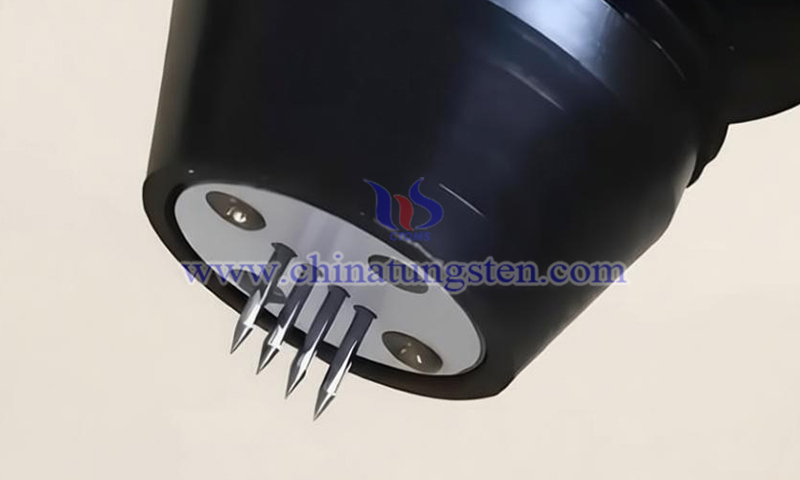
During general signal testing, probes repeatedly contact test points, and any instability may introduce noise or signal fluctuation. Tungsten needles excel in long-term contact stability and low wear. Their contact interface changes slowly during repeated use, maintaining stable contact resistance. CTIA feedback confirms that stable tip morphology effectively reduces signal variation, ensuring consistent test results.
7. CTIA Tungsten Needle for ATE (Automated Test Equipment)Automated Test Equipment (ATE) systems often run continuously for extended periods, requiring probes with long life, stability, and consistency. Tungsten needles endure high-frequency contact and thermal loads. Their low vapor pressure and high melting point minimize material loss under repeated contact. By optimizing sintering density and microstructure, CTIA reduces internal defects, preventing localized failures, extending probe life, and maintaining stable test cycles.
8. CTIA Tungsten Needle for PCB (Printed Circuit Board) TestingPrinted Circuit Board (PCB) testing involves repeated contact with pads or test points, requiring wear resistance and reliable contact. Tungsten needles provide high hardness and geometric stability, minimizing tip wear and surface change over repeated contacts. CTIA controls tip angle and surface consistency to improve repeatability between batches.
9. CTIA Tungsten Needle for ICT (In-Circuit Test)In-Circuit Test (ICT) emphasizes rapid and repetitive detection of circuit nodes. Probes must complete multiple stable contacts in short periods. Tungsten needles offer fatigue resistance and consistent contact force. CTIA ensures uniform material structure to reduce performance drift over long-term use, minimizing false or missed readings.
10. CTIA Tungsten Needle for FCT (Functional Circuit Test)Functional Circuit Test (FCT) verifies circuit functionality, requiring stable signal transmission and contact reliability. Tungsten needles maintain consistent electrical performance through repeated power cycles. Low wear and controlled material purity ensure long-term stable contact, enhancing test reliability.
Across these electronic testing scenarios, the value of tungsten needles derives not from a single property but from the combination of high melting point, stable conductivity, mechanical rigidity, and low wear. CTIA’s experience in material preparation and precision manufacturing ensures these properties are reliably delivered in practical applications, emphasizing long-term consistency and predictability—the key reason tungsten needles remain indispensable in high-end electronic testing.
For any inquiry, please contact tungsten needle manufacturer: CTIA GROUP
Email: sales@chinatungsten.com
Tel: 0086 592 5129696 / 0086 592 5129595
Website: www.tungsten.com.cn
WeChat:

More info>>