
CTIA Tungsten Plate Applied to Aerospace
Tungsten plate offers unique and irreplaceable advantages as a high temperature structurure in the aerospace field. Aerospace components frequently operate under coupled extreme conditions — ultra-high temperatures, high-speed gas flows, intense pressures, and severe thermal shocks — particularly in rocket propulsion systems, hypersonic vehicles, and deep-space exploration equipment.
These demanding environments place exceptionally stringent requirements on materials regarding melting point, high-temperature strength, ablation/erosion resistance, thermal fatigue performance, and long-term dimensional stability. In critical locations such as solid rocket motor nozzle throats, attitude-control engine liners, and localized thermal protection zones of reentry vehicles, structural materials must withstand transient temperatures of several thousand degrees Celsius, accompanied by violent heat-flux scouring, strong oxidation, and high-velocity particle erosion.
As a representative ultra-high-melting-point metal, tungsten — with a melting point of 3422°C and density of 19.3 g/cm³ — maintains relatively high strength and rigidity even above 2000°C, and exhibits ablation resistance far superior to most conventional structural metals. In vacuum or inert atmospheres, its extremely low vapor pressure significantly minimizes volatilization loss; under high heat-flux impact conditions, its high elastic modulus and excellent creep resistance help preserve critical dimensional accuracy. Therefore, tungsten plates provide an irreplaceable material solution for high-temperature structures in aerospace applications.
Drawing from years of specialized supply experience of CTIA, although the volume of tungsten plate applications in aerospace remains relatively niche and selective, a number of customers continue to choose tungsten plates for nozzle throat reinforcement, high-temperature protective liners, and experimental thermal protection test platforms — precisely to satisfy the stringent demands for safety margins and structural reliability under the most extreme service conditions.
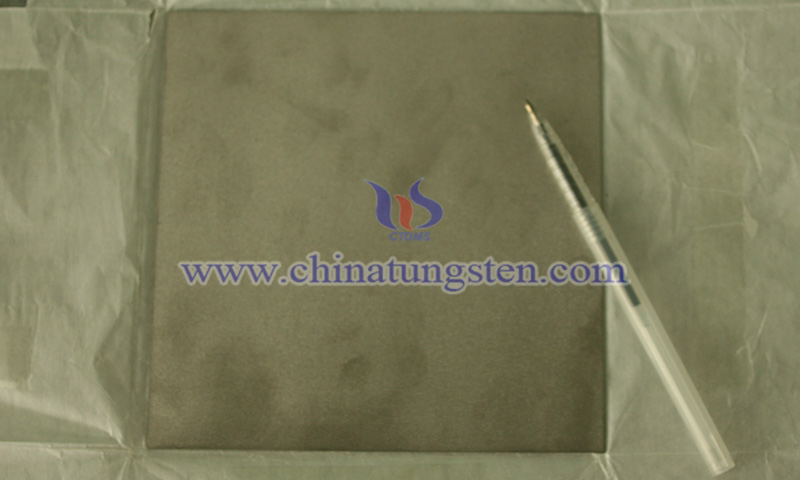
In liquid and solid rocket engines, the combustion chamber and nozzle regions experience extremely high temperatures and high-pressure gas erosion, with gas temperatures exceeding 3000°C and local areas approaching the material’s limit operating temperature. Under such conditions, materials must possess ultra-high melting points along with excellent ablation resistance and high-temperature strength.
CTIA tungsten plates are commonly used for nozzle throat liners, combustion chamber baffles, thermal protection liners, and high-temperature insulation components. The nozzle throat — where gas velocity and heat flux density are highest — endures intense thermal shock and erosive gas flow. Tungsten’s high melting point and low vapor pressure prevent significant sublimation or melting erosion even at extreme gas temperatures.
Tungsten maintains relatively high yield strength and creep resistance at elevated temperatures, resisting plastic flow or dimensional instability under prolonged thermal loads. Its outstanding ablation resistance effectively delays surface degradation, extending the service life and reusability reliability of nozzle components. In some reusable or reentry engine designs, tungsten plates can be combined with copper- or molybdenum-based materials to form composite structures, with gradient transition layers optimizing thermal stress distribution and improving overall structural safety margins.
2. Tungsten Plate for Thermal Protection Systems in Hypersonic VehiclesWhen hypersonic vehicles fly at Mach 5 or above, aerodynamic heating becomes severe, with leading edges, inlet lips, and reentry surfaces reaching temperatures over 2000°C. Materials in these environments must withstand not only high temperatures but also intense thermal shock and cyclic thermal fatigue. Tungsten plates, with excellent high-temperature strength and relatively low thermal expansion coefficient, show strong application potential in leading-edge structures and reentry protection zones. Their low thermal expansion helps reduce thermal stress concentrations caused by temperature gradients, thereby lowering cracking risk.
During reentry, surfaces undergo rapid heating and cooling; materials must exhibit good thermal shock resistance. Under proper microstructure control, tungsten can resist thermal crack propagation to a certain extent. Surface coatings or composite designs can further enhance oxidation resistance, making it more suitable for high-temperature oxidative environments. In hypersonic vehicle thermal protection systems, tungsten plates are typically employed as localized reinforced protective materials in the highest heat-flux regions to improve overall structural durability and safety.
3. Tungsten Plate for Satellite Counterweights and Inertial Structural ComponentsIn satellite systems, mass distribution directly affects attitude control accuracy and orbital stability. Due to their high density, CTIA tungsten plates provide substantial mass in limited volumes and are commonly used for counterweight blocks in attitude control systems, momentum wheel balance masses, and inertial structural components.
Through precision machining, tungsten plates enable high-accuracy mass control, facilitating fine center-of-mass adjustments and improving attitude control system response precision. Their high strength and structural stability ensure negligible deformation under launch vibration and orbital temperature cycling. During complex orbital maneuvers or long-duration missions, tungsten’s dimensional stability helps maintain stable inertial parameters, thereby enhancing long-term reliability of the attitude control system.
4. Tungsten Plate for Localized Reinforced Structures in Reentry Vehicles and Ballistic PayloadsIn ballistic vehicles or reentry return capsules, nose cones and leading-edge regions experience extreme aerodynamic heating and impact loads. Tungsten plates can be used for localized ablation-resistant reinforcement structures to enhance thermal erosion resistance in critical areas. Thanks to their high density, they also serve dual functions of structural reinforcement and mass adjustment in certain kinetic penetration structures or high-speed impact environments. Under extreme high-temperature and high-pressure conditions, tungsten maintains structural integrity, increasing the overall safety factor.
5. Tungsten Plate for Electric Propulsion and Plasma-Contact ComponentsIn electric propulsion systems such as Hall thrusters or ion engines, discharge channels and localized plasma-contact regions must withstand high-temperature plasma impingement. Tungsten plates, with low sputter yield and excellent resistance to ion bombardment, are suitable for erosion-resistant structures or electrode assemblies. Under high-energy particle bombardment, tungsten reduces sputtered contamination, improving propulsion system stability and lifetime — a particularly important advantage for deep-space exploration missions.
6. Tungsten Plate for Space Nuclear Power and High-Temperature Energy System StructuresIn future space nuclear power systems or high-temperature energy conversion systems, materials must endure coupled high-temperature and irradiation environments. Tungsten plates can be used for localized shielding structures or high-temperature structural supports to enhance system operational stability. Their high melting point and radiation resistance offer good application prospects in high-temperature nuclear thermal environments. Through alloying and microstructure optimization, embrittlement resistance can be further improved to meet long-term service requirements.
The applications of tungsten plates in the aerospace field cover high-temperature rocket engine components, hypersonic vehicle thermal protection systems, satellite counterweights and inertial structures, localized reinforcement in reentry vehicles, erosion-resistant parts in electric propulsion, and structures in space nuclear power systems. Their core advantages lie in ultra-high melting point, excellent high-temperature strength, superior ablation resistance, high density, and outstanding dimensional stability.
As reusable launch vehicles, hypersonic flight, and deep-space exploration technologies continue to advance, the demand for high-performance high-temperature-resistant materials will keep growing. Tungsten plates, as an important component of extreme thermal environment structural materials, will continue to play a critical supporting role in the future manufacturing ecosystem of high-end aerospace equipment.
For any inquiry, please contact tungsten plate manufacturer: CTIA GROUP
Email: sales@chinatungsten.com
Tel: 0086 592 5129696 / 0086 592 5129595
Website: www.tungsten.com.cn
WeChat:

More info>>