
Common Questions and Answers About Tungsten Crucible
Basic Information of Tungsten Crucibles
Q1: What’s Tungsten Crucible?
A: Tungsten crucible is a high-temperature container manufactured from high-purity tungsten (W) or tungsten-based alloys. Tungsten crucible is mainly used for smelting, evaporative deposition, sintering, and single crystal growth under ultra-high temperature, vacuum, inert atmosphere, or high-purity hydrogen conditions.
Tungsten is a refractory metal with a melting point of approximately 3422°C, making it one of the highest among all pure metals. Therefore, tungsten crucible is typically applied in extreme environments above 2000°C.
Tungsten crucible has wide applications in sapphire single crystal growth, GaN/GaAs semiconductor crystal growth, vacuum thermal evaporation, rare earth smelting, superalloy melting, electron beam evaporation sources, MBE (Molecular Beam Epitaxy), and nuclear and aerospace materials research. Tungsten crucible plays a critical role in semiconductor, monocrystalline, and superalloy industries.
Q2: Why Does High-Temperature Industry Prefer Tungsten Crucibles?
A: High-temperature industries such as sapphire growth, rare earth smelting, specialty glass melting, and MBE place extremely strict requirements on crucible materials, including structural stability and chemical purity under extreme temperatures. Tungsten crucible is widely preferred due to the following key advantages:
(1) Extremely High Melting Point (3422°C)
Tungsten has the highest melting point among all metals, far exceeding molybdenum (2623°C) and tantalum (3017°C). This allows tungsten crucible to operate for long periods at 2000–3000°C without softening or deformation.
(2) Excellent High-Temperature Mechanical Strength
Tungsten maintains high tensile strength and creep resistance above 2000°C. In contrast, ceramic crucibles such as alumina and zirconia are prone to cracking, while graphite softens and deforms at high temperatures.
(3) High Mechanical Strength at High Temperatures
Many materials experience sharp decline in strength when approaching melting points, but tungsten retains high tensile strength and creep resistance above 2000°C. In contrast, ceramic crucibles, such as alumina and zirconia, crack easily at high temperatures, and graphite materials soften significantly, leading to collapse. High-temperature strength of tungsten ensures dimensional stability and service life of crucible during multiple thermal cycles.
(4) Extremely Low Vapor Pressure
In high-temperature vacuum or low-pressure environments, volatilization of materials contaminates growth environments and products. Vapor pressure of tungsten at 2000°C is only approximately 10⁻⁵ Pa, far lower than that of most metals and compounds. This means even under high vacuum conditions above 10⁻⁴ Pa, tungsten crucible itself barely volatilizes, thereby ensuring cleanliness of process chamber.
(5) Stable Thermal Shock Resistance and Thermal Stability
Tungsten possesses high thermal conductivity, approximately 173 W·m⁻¹·K⁻¹, and low coefficient of thermal expansion, approximately 4.5×10⁻⁶/K, making it less prone to cracking due to thermal stress during rapid heating or cooling processes. This thermal stability is critical for industrial processes requiring frequent material reloading or thermal cycling.
(6) Extremely Low Contamination to Vacuum Environments and Products
Crucibles manufactured from high-purity tungsten, purity reaching over 99.999%, release almost no harmful impurities such as carbon, oxygen, and nitrogen at high temperatures. Especially in inert gases, such as argon, or reducing atmospheres, volatile oxides do not form on tungsten surface, resulting in highly stable chemical properties. This allows tungsten crucible to be widely applied in sectors with strict purity requirements, such as semiconductors, optical crystals, and high-end alloys.
(7) Verified Chemical Compatibility with Multiple Melts
Tungsten exhibits low corrosion rates against many high-temperature melts, such as liquid aluminum, rare earth metals, and sapphire melt Al₂O₃, making it less prone to reaction or alloying. In contrast, certain metals, such as iron and nickel, rapidly corrode tungsten at high temperatures. Therefore, tungsten crucible is not applicable to all melts, but it performs reliably in oxide crystal growth and refractory metal smelting.
(8) Advantages over Other Materials
High-temperature performance comparison between tungsten crucible and other common crucible materials is presented in picture below:
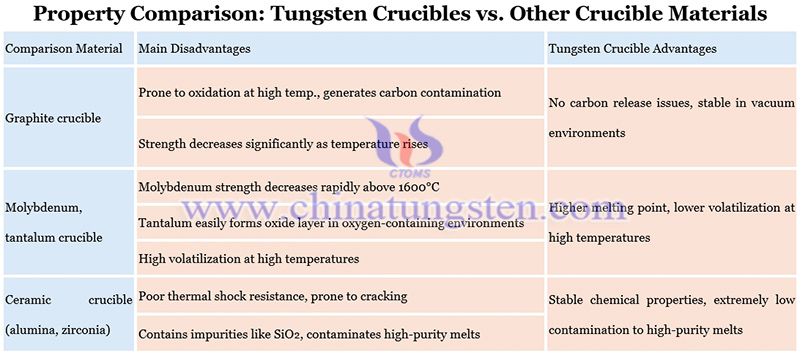
Tungsten crucible has become irreplaceable material in harsh high-temperature environments above 2000°C due to high melting point, high-temperature strength, low vapor pressure, low contamination, stable thermal stability, and chemical inertness. Although manufacturing cost of tungsten crucible is relatively high, its all-around performance edge far exceeds those of other materials in high-end industrial fields such as sapphire crystal growth, rare earth and special alloy smelting, and MBE source furnaces, earning widespread adoption.
Q3: What Are Differences Between Tungsten Crucible and Molybdenum Crucible?
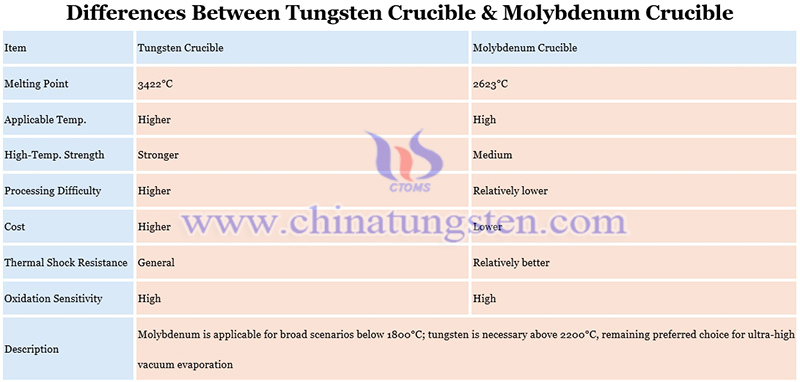
Primary differences between tungsten crucible and molybdenum crucible are listed in picture below:
Q4: What Are Typical Shapes of Tungsten Crucibles?
Tungsten crucible is widely applied in high-end fields such as sapphire crystal growth, rare earth smelting, glass melting, electron beam evaporation deposition, and molecular beam epitaxy (MBE) due to stable performance including high temperature resistance, low vapor pressure, and thermal shock resistance. Tungsten crucible shapes vary across process requirements and application scenarios, primarily featuring following geometries:
(1) Cylindrical Shape
This configuration is most common and basic shape. Processing is relatively simple, making it suitable for variety of smelting and evaporation processes. Inner and outer walls usually present concentric circle structure, facilitating uniform heating and thermal field layout.
(2) Tapered Shape (Inverted Cone or Regular Cone)
Tapered structure is beneficial for concentrated heating and directional evaporation of materials, which is common in electron beam evaporation or thermal evaporation coating equipment. Inverted cone design can also facilitate demolding, used for powder metallurgy or ingot molding processes.
(3) Rimmed Structure
This configuration features outward or inward flanges set on upper edge of cylindrical or tapered crucibles. Flanged structure is mainly used to enhance structural stability of crucible, preventing collapse due to softening or stress at high temperatures. Meanwhile, flanged structure facilitates fixing crucible position in heating furnaces or evaporation sources.
(4) Lidded Structure
To prevent melt splashing at high temperatures, reduce volatile loss, or control evaporation rates, portion of tungsten crucibles equips matching tungsten lid. This structure is often used for high-purity material smelting or directional deposition in vacuum thermal evaporation.
(5) Evaporation Boat Shape
Evaporation boat shape typically presents elongated, boat-like, or trough-like structure, mainly used for resistance heating evaporation coating equipment. Evaporation tungsten boat features large open area and concentrated heating zone, suitable for vapor deposition of metal materials such as aluminum, silver, and gold.
(6) Deep Cavity Type
Deep cavity crucible possesses large height-to-diameter ratio, suitable for processes requiring long heating times or large charging capacities, such as polysilicon ingot casting and rare earth metal smelting. Deep cavity structure helps reduce thermal radiation loss and improve thermal efficiency.
(7) Core Structural Components for Molecular Beam Epitaxy (MBE) Evaporation Source Furnaces or Effusion Cells
This type of crucible belongs to ultra-high vacuum components, usually using high-purity tungsten or tungsten alloys. Shape is elongated nozzle or flux-limiting structure with precise orifice. It is designed to generate stable, controllable molecular or atomic beam for epitaxial growth of single crystal thin films on semiconductor substrates. Requirements for material purity, wall thickness uniformity, and exit orifice precision are extremely high.
(8) Special-Shaped Customized Structures
For non-standard processes or special equipment, tungsten crucibles need customized designs based on client heating methods, furnace structures, or material characteristics. Shapes may include elliptical, rectangular, asymmetrical structures, and multi-cavity integrated structures.
(9) Derived Shapes under Special Process Requirements
In certain high-tech or high-end manufacturing industries, tungsten crucibles are attached with additional performance indicators, deriving finer shape requirements:
Ultra-Thin Wall Structure: Used for rapid thermal response or space-constrained heating environments.
High Concentricity Structure: Guarantees heating uniformity and consistency in evaporation direction.
Inner Wall Mirror Finish Structure: Reduces melt residue and improves material release rate, commonly used for MBE or high-purity metal vapor deposition.
Ultra-Low Porosity Structure: achieved through special sintering or forging processes to reduce contamination of vacuum environments caused by gas release.
Q5: How Are Tungsten Crucibles Manufactured?
A: Tungsten crucible is usually manufactured using powder metallurgy process, which is core technical route to achieve high purity, high density, and complex shapes in tungsten products. Basic process consists of following key steps:
(1) Raw Material Preparation: High-purity tungsten powder serves as raw material, with purity requirements usually reaching 99.95% or higher. Tungsten powder is generally produced through hydrogen reduction of tungstates, such as ammonium paratungstate (APT). High-end products also apply technologies like plasma sphericalization for secondary treatment of tungsten powder to obtain ultra-fine tungsten powder with uniform particle size and high sphericity.
(2) Molding: Cold isostatic pressing is mainstream method. By applying uniform omnidirectional pressure to tungsten powder in high-pressure liquid environment, cold isostatic pressing obtains green body with uniform density distribution and moderate strength, which is particularly suitable for manufacturing of large-sized or thick-walled crucibles. For small batches or crucibles with simpler shapes, die pressing molding can also be applied.
(3) High-Temperature Sintering: High-temperature sintering treats pressed green bodies at 1700–2400°C using medium-frequency induction or vacuum furnaces under hydrogen or vacuum atmospheres. Divided into pre-sintering and densification, process first consolidates tungsten powder particles at lower temperatures, then accelerates atomic diffusion at higher temperatures to build continuous grain structures, increasing crucible strength and high-temperature durability.
(4) Hot Isostatic Pressing (HIP): High-end products require hot isostatic pressing treatment post-sintering. By eliminating internal micro-voids and residual stresses under high temperature and high pressure, this treatment delivers tungsten crucibles with density matching ≥98% of theoretical value.
(5) Mechanical Machining: Precision machining processes sintered blanks through CNC turning, inner wall polishing, and edge chamfering to meet target dimensions and surface standards. High hardness and inherent brittleness of tungsten require specialized carbide tools and cooling lubricants during machining.
(6) Surface Treatment and Coating: Protective coatings (molybdenum, tungsten-tantalum alloy, or nitrided layers) are applied to specific crucibles to increase high-temperature oxidation and corrosion resistance.
(7) Electron Beam Welding: Electron beam technology welds multiple sintered parts into single structures for ultra-large or complex crucibles, meeting specific application needs.
(8) Quality Inspection and Packaging: Finished items undergo verification of dimensional precision, density (98% of theoretical density), metallographic structure, impurity limits, and vacuum leakage. Qualified lots are packed under vacuum or inert gas to block oxidation and contamination.
Alternative manufacturing methods include forging, chemical vapor deposition (CVD), spinning, and plasma spraying, though powder metallurgy is primary technical route. Premium tungsten crucibles merge high-purity powder with hot isostatic pressing densification to achieve target high-temperature stability and extended service life.
Operating Temperatures and Environmental Issues of Tungsten Crucibles
Q6: What Is Maximum Operating Temperature of Tungsten Crucible?
A: Theoretically, tungsten melting point is 3422°C, reaching over 3000°C briefly under vacuum. Actual long-term operation tracks at 2400–2800°C under vacuum, 2200–2600°C in hydrogen, and 2000–2500°C in argon environments. High-temperature use is excluded in regular air. Exceeding 2800°C causes grain coarsening, accelerated creep, high evaporation rates, and reduced structural life of tungsten crucible.
Basic Information of Tungsten Crucibles
Q1: What’s Tungsten Crucible?
Q2: Why Does High-Temperature Industry Prefer Tungsten Crucibles?
Q3: What Are Differences Between Tungsten Crucible and Molybdenum Crucible?
Q4: What Are Typical Shapes of Tungsten Crucibles?
Q5: How Are Tungsten Crucibles Manufactured?
Operating Temperatures and Environmental Issues of Tungsten Crucibles
Q6: What Is Maximum Operating Temperature of Tungsten Crucible?
Q7: Why Can't Tungsten Crucibles Be Used in Air at High Temperatures?
Q8: Can Tungsten Crucible Be Used in Oxygen Environments?
Q9: Is Tungsten Crucible Suitable for Vacuum Environments?
Q10: Is Tungsten Crucible Suitable for Hydrogen Environments?
Q11: Can Tungsten Crucible Withstand Thermal Shock?
Q12: Why Do Tungsten Crucibles Crack?
Q13: Why Do Tungsten Crucibles Become Brittle?
Chemical Compatibility Issues of Tungsten Crucible
Q14: Will Tungsten Crucible Contaminate Melt?
Q15: Which Materials React Easily with Tungsten?
Q16: Can Tungsten Crucible Be Used to Melt Aluminum?
Q17: Is Tungsten Crucible Suitable for Rare Earth Smelting?
Q18: Is Tungsten Crucible Suitable for Sapphire Growth?
Q19: Is Tungsten Crucible Suitable for Semiconductor Industry?
Lifespan and Failure Issues of Tungsten Crucible
Q20: What Is Typical Lifespan of Tungsten Crucible?
Q21: How to Judge if Tungsten Crucible Has Failed?
Q22: Why Do Some Tungsten Crucibles Have Exceptionally Short Lifespan?
Q23: Can Tungsten Crucible Be Repaired?
Q24: Why Do Tungsten Crucibles Deform?
Processing and Manufacturing Issues of Tungsten Crucibles
Q25: Why Are Tungsten Crucibles So Expensive?
Q26: Why Are Tungsten Crucibles Difficult to Process?
Q27: Why Are Tungsten Crucibles Prone to Welding Cracks?
Q28: Why Is Purity of Tungsten Crucible Important?
Q29: Why Is HIP Process Key to Tungsten Crucible Production?
Operations and Maintenance Issues of Tungsten Crucibles
Q30: Do Tungsten Crucibles Need Preheating Before Use?
Q31: What Is Recommended Heating Rate for Tungsten Crucible?
Q32: Do Tungsten Crucibles Require Slow Cooling?
Q33: How Should Tungsten Crucibles Be Stored and Transported?
Q34: Can Tungsten Crucible Be Cleaned?
Q35: How Can Oxidation of Tungsten Crucibles Be Prevented?
Q36: Why Does Inner Wall of Tungsten Crucible Coarsen?
Application Industries of Tungsten Crucibles
Q37: Why Do MBE Systems Utilize Tungsten Crucibles?
Q38: Why Use Tungsten Crucibles in Electron Beam Evaporation?
Q39: What Technical Challenges Do Tungsten Crucibles Face in Sapphire Industry?
Q40: Can Tungsten Crucibles Be 3D Printed?
Procurement and Selection Issues of Tungsten Crucibles
Q41: What Are Most Important Parameters When Purchasing Tungsten Crucibles?
Q42: Is Thicker Wall Always Better for Tungsten Crucible?
Q43: Do Tungsten Crucibles Require Polishing?
Q44: What Are Differences Between Domestic and Imported Tungsten Crucibles?
Q45: Are Tungsten Crucibles Classified as Consumables?
Extreme Operating Environments and Research Issues of Tungsten Crucibles
Q46: Are Tungsten Crucibles Suitable for Nuclear Industry?
Q47: Why Do UHV Systems Require High Purity Tungsten Crucibles?
Q48: Why Does Grain Coarsening Occur in Tungsten Crucibles?
Q49: Why Do Tungsten Crucibles Have Low Evaporation Contamination?
Q50: What Are Future Technological Development Directions for Tungsten Crucibles?
Q51: What Key Operational Errors Affect Tungsten Crucibles?
Q52: What Are Primary Advantages and Disadvantages of Tungsten Crucibles?
High-Frequency Industry Questions from International Market
1. Can Tungsten Crucibles Be Used in Oxidizing Atmospheres?
2. Why Do Tungsten Crucibles Crack?
3. Are Tungsten Crucibles Chemically Inert?
4. How To Extend Tungsten Crucible Lifetime?
For any inquiry, please contact tungsten crucible manufacturer: CTIA GROUP
Email: sales@chinatungsten.com
Tel: 0086 592 5129696 / 0086 592 5129595
Website: www.tungsten.com.cn
WeChat:

More info>>