
What Are Main Manufacturing Processes of Tungsten Crucible?
Main manufacturing processes of tungsten crucible generally revolve around the forming, densification, and structural machining of high-purity tungsten materials. Different processes directly affect the crucible density, grain structure, high-temperature performance, and final application scenarios.
Tungsten crucible manufacturing is fundamentally based on powder metallurgy, completed in coordination with various plastic deformation and precision machining. Currently, four primary manufacturing processes classify industrial production of tungsten crucible:
1. Tungsten Crucible Manufacturing Processes: Sintering
Sintering is currently the mainstream manufacturing process for large size tungsten crucibles, such as those used in sapphire crystal growth furnaces with diameters exceeding 200 mm.
The simplified process flow for sintered tungsten crucible involves: tungsten powder undergoes Cold Isostatic Pressing (CIP) to compress the powder into a crucible green compact under high pressure, followed by high-temperature sintering in a vacuum or hydrogen-protected atmosphere at 1800°C to 2300°C, and final dimensional trimming through machining.
Sintering process is suitable for manufacturing cylindrical or tapered crucibles with large dimensions and thick walls, offering good structural stability and relatively controllable production costs. However, because the microstructure consists primarily of as-sintered grain structures with coarser grains, its density and creep resistance are slightly lower than those of deformed components. The density of sintered tungsten crucible ranges generally from 18.0 to 18.5 g/cm³, representing approximately 93% to 96% of the theoretical density.
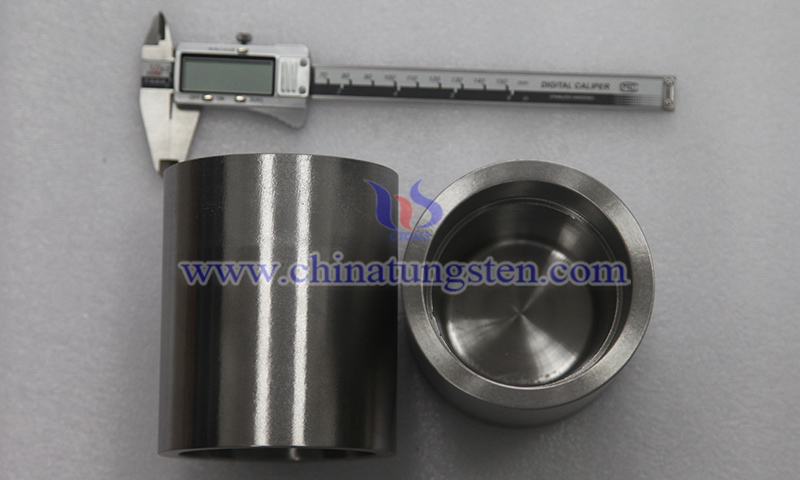
2. Tungsten Crucible Manufacturing Processes: Spinning
Spinning is a typical high-temperature plastic deformation process, frequently utilized for manufacturing small-to-medium sized, thin wall tungsten crucibles.
The simplified process flow for spun tungsten crucible involves: tungsten powder is sintered into dense tungsten billets or plates, then heated to a plastic state of approximately 1000°C to 1400°C, and gradually pressurized by rollers on spinning equipment to induce plastic flow over a mandrel to conform to the mold shape.
Spinning process significantly improves material density, enabling the theoretical density of spun tungsten crucible to reach 19.1 to 19.25 g/cm³. Spun crucible exhibits distinct grain refinement, excellent wall thickness uniformity, high inner wall surface finish, and superior high-temperature creep resistance and service life compared to regular sintered tungsten crucible. However, it requires advanced equipment, involves complex processing, presents challenges in manufacturing large size tungsten crucibles, and incurs relatively high costs.
3. Tungsten Crucible Manufacturing Processes: Machining
Machining uses high-density tungsten rods or tungsten forgings as raw materials, directly forming the crucible through precision turning on CNC machine tools.
The simplified process flow for machined tungsten crucible involves: tungsten powder undergoes sintering followed by forging to enhance density and grain properties, and then a lathe is utilized for internal cavity hollowing, external profiling, and dimensional fine-tuning.
Machining process is applicable to small-sized, miniature, or structurally complex tungsten crucibles, such as laboratory crucibles, evaporation boats, or specialized custom shapes. Its advantages include high machining accuracy, superior surface quality, and structural flexibility. The disadvantages are low material utilization rates, high machining waste, and unsuitability for manufacturing large size thin wall structures.
4. Tungsten Crucible Manufacturing Processes: Welding
Welding is primarily applied to manufacture non-standard large-sized or specialized structural tungsten crucibles, such as boat-shaped, box-shaped, or modular configurations.
The simplified process flow for welded tungsten crucible involves: tungsten plates are cut and bent into shape, joined via Electron Beam Welding (EBW) or Tungsten Inert Gas Welding (TIG), and subsequently subjected to post-weld heat treatment to relieve residual stress.
Welding process offers high structural flexibility, bypassing mold restrictions to achieve complex custom designs. However, due to the poor weldability of tungsten materials, the weld zone is prone to porosities, cracks, and recrystallization embrittlement. Consequently, the overall strength and high-temperature stability are generally lower than those of integrally formed crucibles, making them mostly suitable for scenarios with relatively moderate load-bearing requirements.
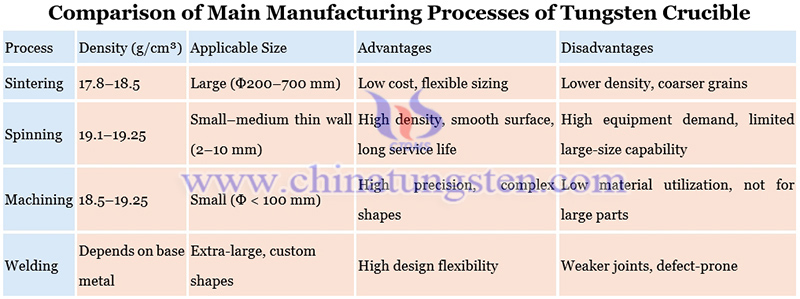
The comparison of main manufacturing processes for tungsten crucible is shown in picture below:
With over 30 years of deep expertise in tungsten crucible manufacturing, CTIA GROUP consistently provides a full range of sintered, forged, and spun tungsten crucibles covering laboratory to industrial applications through a comprehensive specification system. It fully supports customization of large-size, high-purity, thin-walled, and non-standard structures to precisely match diverse vacuum high-temperature equipment and thermal fields.
For any inquiry, please contact tungsten crucible manufacturer: CTIA GROUP
Email: sales@chinatungsten.com
Tel: 0086 592 5129696 / 0086 592 5129595
Website: www.tungsten.com.cn
WeChat:

More info>>