
Tungsten Crucible vs. Molybdenum Crucible
Tungsten crucible and molybdenum crucible are both refractory metal crucibles widely applied in vacuum high-temperature environments, inert atmospheres, and high-purity material preparation processes. Although their application fields overlap, significant differences exist in their melting points, vapor pressures, high-temperature stability, and suitable operating conditions, etc.
1. Tungsten Crucible vs. Molybdenum Crucible: Comparison of Material Properties
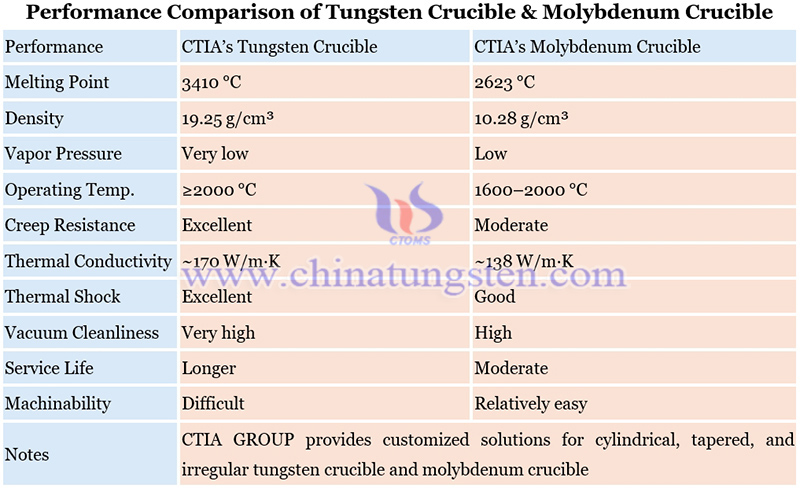
(1) Tungsten Crucible: Made of high-purity tungsten (≥99.95% W), featuring a melting point of about 3410°C (highest among metals), minimal vapor pressure, and superior grain stability at elevated temperatures.
(2) Molybdenum Crucible: Made of high-purity molybdenum (≥99.95% Mo) with a melting point of about 2623°C, showing good strength and stability under medium to high temperatures but performance declines more rapidly at higher temperatures.
2. Tungsten Crucible vs. Molybdenum Crucible: Comparison of High-Temperature Range and Thermal Stability
(1) Tungsten Crucible: Capable of long-term operation above 2000°C, making it suitable for ultra-high temperature applications and complex thermal field environments.
(2) Molybdenum Crucible: Generally applicable within a temperature range of 1600–2000°C. Beyond this range, phenomena such as creep and grain growth become significantly more pronounced.
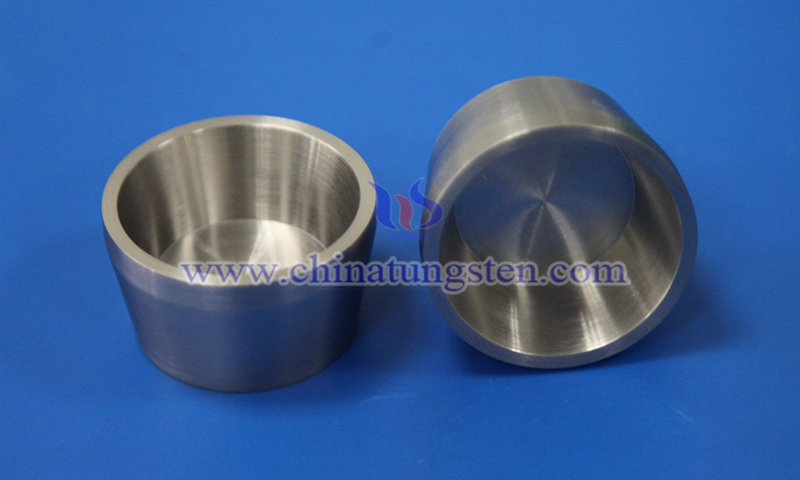
3. Tungsten Crucible vs. Molybdenum Crucible: Comparison of Vacuum Performance and Material Purity
(1) Tungsten Crucible: Low vapor pressure under high vacuum minimizes contamination, suitable for ultra-pure processes.
(2) Molybdenum Crucible: Stable in vacuum, but ultra-high purity processes need stricter control.
4. Tungsten Crucible vs. Molybdenum Crucible: Comparison of Structural Stability and Creep Resistance
(1) Tungsten Crucible: Maintains a low creep rate under high-temperature loads, ensuring greater structural stability during long-term use.
(2) Molybdenum Crucible: Stable under medium-to-high temperature conditions, but possesses slightly lower deformation control capabilities during prolonged high-temperature cycling.
5. Tungsten Crucible vs. Molybdenum Crucible: Comparison of Applications
(1) Tungsten Crucible: Frequently used in sapphire crystal growth, semiconductor crystal growth, monocrystalline silicon melting, electron beam evaporation, ultra-high vacuum coating, aerospace superalloy preparation, and nuclear experiments, suitable for ultra-high-temperature and high-cleanliness scenarios.
(2) Molybdenum Crucible: Suitable for medium-to-high temperature vacuum heat treatment, conventional metal melting, electronic material processing, and general high-temperature experimental environments. Performance comparison of tungsten crucible and molybdenum crucible is shown as the picture bellow:
Drawing on over 30 years of manufacturing expertise, CTIA GROUP delivers optimized tungsten crucible and molybdenum crucible solutions through comprehensive, end-to-end customized services. These solutions encompass material selection, structural design, and precision fabrication, engineered to meet the specific vacuum and thermal field requirements.
For any inquiry, please contact tungsten crucible manufacturer: CTIA GROUP
Email: sales@chinatungsten.com
Tel: 0086 592 5129696 / 0086 592 5129595
Website: www.tungsten.com.cn
WeChat:

More info>>