
Tungsten Crucible Selection Guide
CTIA GROUP has over 30 years of experience in tungsten crucible manufacturing, serving sapphire crystal growth, high-temperature melting, and vacuum thermal field applications. Tungsten crucible is a critical component in ultra-high-temperature environments, and its structure, manufacturing process, and dimensional parameters directly affect thermal field stability, material purity, and equipment service life. Proper selection is essential for stable operation.
1. CTIA's Tungsten Crucible Selection: Operating Temperature
Operating temperature is a key parameter in tungsten crucible selection. Based on long-term application experience, sintered tungsten crucible is typically used for conditions below 2200°C. For continuous operation above 2400°C, spun or forged structures are preferred to improve high-temperature creep resistance and thermal stability.
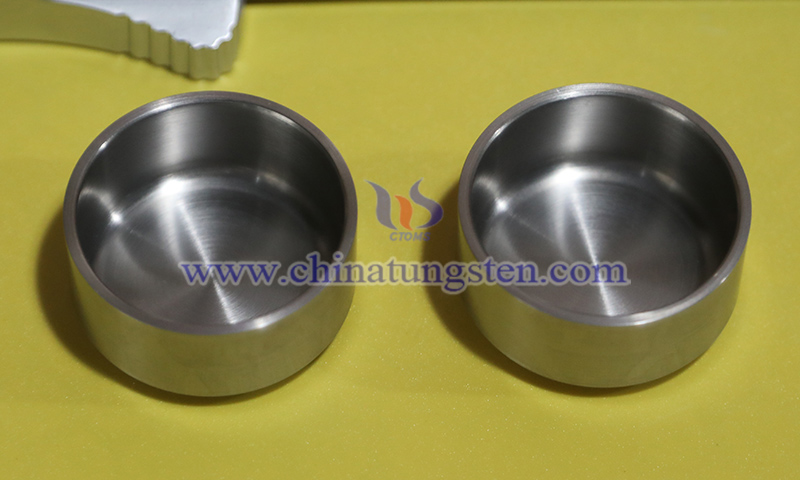
2. CTIA's Tungsten Crucible Selection: Thermal Field Structure and Loading Mode
Thermal field structure directly determines heating uniformity and crucible geometry selection. Cylindrical tungsten crucible is suitable for most vacuum melting and crystal growth systems. Conical structures improve melt flow and discharge efficiency. Lidded structures are used for processes requiring evaporation control. Irregular structures are applied in customized thermal field systems.
3. CTIA's Tungsten Crucible Selection: Manufacturing Process
Crucible size, operating temperature, and thermal cycling conditions determine the appropriate manufacturing process. Large-size and long-cycle applications generally adopt sintered or spun structures, while small-size precision systems use forged and machined structures. Process selection must consider microstructure control and processing parameters to ensure high-temperature stability and service life. Comparison of tungsten crucible manufacturing processes is shown in picture below:
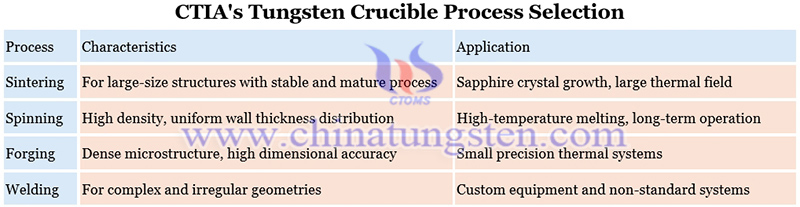
Manufacturing processes significantly influence microstructure, density, and high-temperature service life. CTIA GROUP selects optimized process routes based on dimensional accuracy, thermal performance, and service life requirements.
In summary, tungsten crucible selection requires comprehensive consideration of operating temperature, thermal field structure, loading mode, and manufacturing process. These factors directly affect thermal stability, temperature uniformity, and service life.
Proper selection reduces thermal shock and structural failure risks while improving material purity retention and equipment reliability. Optimized matching of operating conditions and structural design ensures stable long-term performance in high-temperature environments.
For any inquiry, please contact tungsten crucible manufacturer: CTIA GROUP
Email: sales@chinatungsten.com
Tel: 0086 592 5129696 / 0086 592 5129595
Website: www.tungsten.com.cn
WeChat:

More info>>