
Manufacturing Process Flow of CTIA's Tungsten Crucible
CTIA GROUP establishes a systematized production process flow based on diverse structural designs and application requirements. Multi-process coordinated control ensures stable and consistent material performance and forming quality. The manufacturing process flow of CTIA's tungsten crucible is as follows:
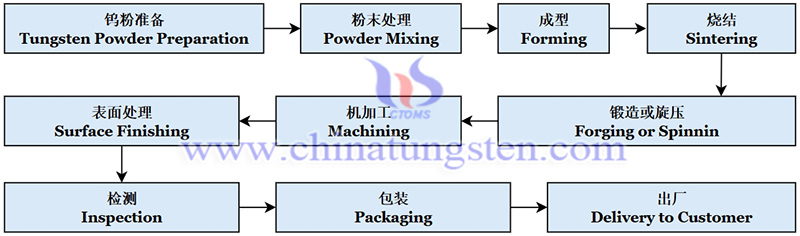
Manufacturing Process Flow of CTIA's Tungsten Crucible
1. High Purity Tungsten Powder Preparation
CTIA GROUP implements strict purity qualification and particle size control on raw high-purity tungsten powder. Sieving and homogenization processes provide a stable particle size distribution and good fluidity, ensuring subsequent densification consistency. The contents of oxygen, carbon, iron, and other impurities are strictly limited to prevent grain boundary weakening and structural instability during high-temperature service.
2. Blending and Homogenization Treatment
Multi-batch raw material blending and homogenization equalize the physical state of tungsten powders from different sources. This ensures uniform and stable density distribution during pressing, reducing shrinkage variance and microstructural segregation during subsequent sintering.
3. Forming
Cold isostatic pressing or die pressing compacts tungsten powder into a compact with adequate green strength. Strict control over pressure transfer uniformity ensures a uniform internal density distribution, establishing a stable structural foundation for subsequent sintering. Additionally, near-net-shape preforming designs enhance forming efficiency for complex structures.
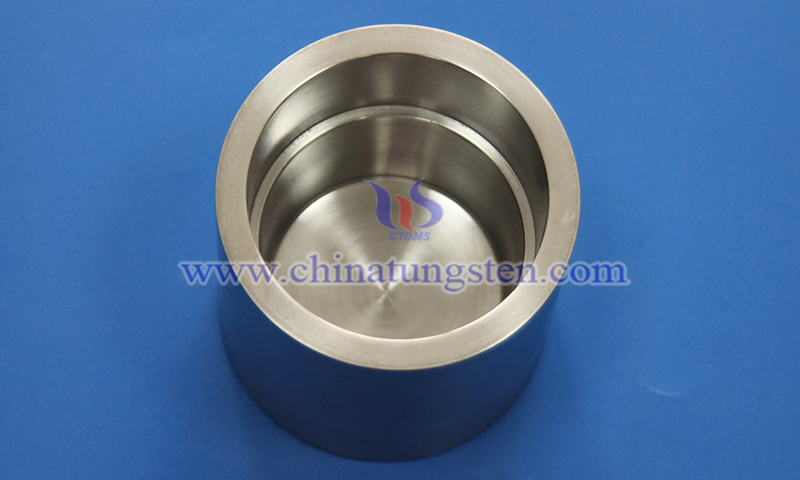
4. High Temperature Sintering and Densification
High-temperature vacuum or hydrogen-protected environments facilitate solid-state diffusion among tungsten particles, gradually developing a dense metallic skeleton while precise thermal profile control eliminates internal pores. For high-end applications, secondary or gradient sintering further refines the grain structure, elevating high-temperature creep resistance and structural stability.
5. Plastic Deformation
Forging or spinning processes further refine the material microstructure. Forging enhances overall densification and grain uniformity for thick-walled structures; spinning delivers progressive wall thickness control and high dimensional consistency for large-size or thin-walled designs, adapting to varied thermal field requirements.
6. Intermediate Annealing
Intermediate annealing releases internal residual stresses, restores plasticity, and stabilizes the grain structure. This lowers cracking risks during subsequent processing and high-temperature service, raising overall structural reliability.
7. Precision Machining
Precision CNC machining achieves rigorous dimensional corrections and structural tolerance control through inner and outer wall turning, as well as end-face facing. This process eliminates manufacturing tolerances inherited from previous stages, ensuring dimensional consistency and precise fit during assembly and high-temperature service.
8. Surface Treatment and Quality Control
Polishing, blasting, and cleaning remove machining residues and micro-defects, maximizing surface cleanliness and stability under high temperatures. Multidimensional testing evaluates density, dimensions, and microstructure, while process parameter feedback continuously optimizes production to ensure reliable service under thermal cycling.
For any inquiry, please contact tungsten crucible manufacturer: CTIA GROUP
Email: sales@chinatungsten.com
Tel: 0086 592 5129696 / 0086 592 5129595
Website: www.tungsten.com.cn
WeChat:

More info>>