
CTIA’s Tungsten Crucible in Rare Earth & Refractory Metal Melting
Tungsten crucible is widely used in rare earth and refractory metal melting, where high vacuum or high-purity inert gas atmospheres are required to prevent oxidation and impurity contamination. Due to excellent high-temperature structural stability and extremely low volatilization characteristics, tungsten crucible has become a key container in these high-temperature molten environments.
Rare earth and refractory metal melting processes are typically conducted under 10⁻³–10⁻⁶ Pa vacuum or high-purity argon (Ar) protection, placing stringent requirements on material creep resistance, thermal stability, and interfacial compatibility. With a melting point of 3,420°C, tungsten can maintain relatively stable mechanical properties above 2,000°C, making it suitable for long-cycle high-temperature melting applications.
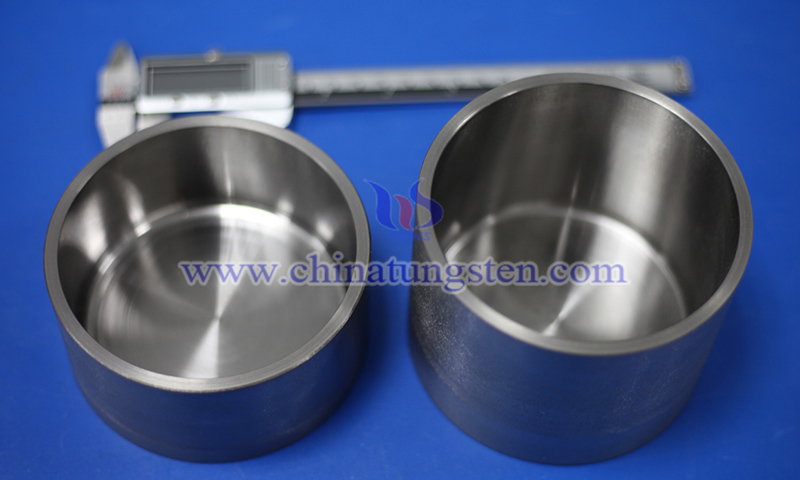
1. Why Is CTIA’s Tungsten Crucible Suitable for Rare Earth Metal Melting?
Rare earth metals such as neodymium (Nd), dysprosium (Dy), and terbium (Tb) are highly chemically active. During melting, oxygen (O), carbon (C), and impurity elements must be strictly controlled, often at ppm levels.
In vacuum induction melting (VIM) or argon-protected conditions, tungsten crucibles provide a stable high-temperature molten environment, reducing the risk of interface reactions between the crucible and molten material. Sensitivity to crucible outgassing behavior and high-temperature dimensional stability varies among different rare earth systems, which is a key factor affecting purity control and composition consistency.
2. Why Is CTIA’s Tungsten Crucible Suitable for Refractory Metal Melting?
Refractory metals such as tungsten (W), molybdenum (Mo), tantalum (Ta), and niobium (Nb) have melting points generally above 2,400°C, with some approaching or exceeding 3,000°C. Melting processes demand high thermal load capacity and structural integrity.
Tungsten crucibles are used in Electron Beam Melting (EBM) and Vacuum Arc Melting (VAM) processes, maintaining structural stability under short-cycle high-temperature shock conditions. Experience shows that structural stability and dimensional retention under high-temperature cycling are critical for maintaining a stable molten pool shape and uniform material microstructure.
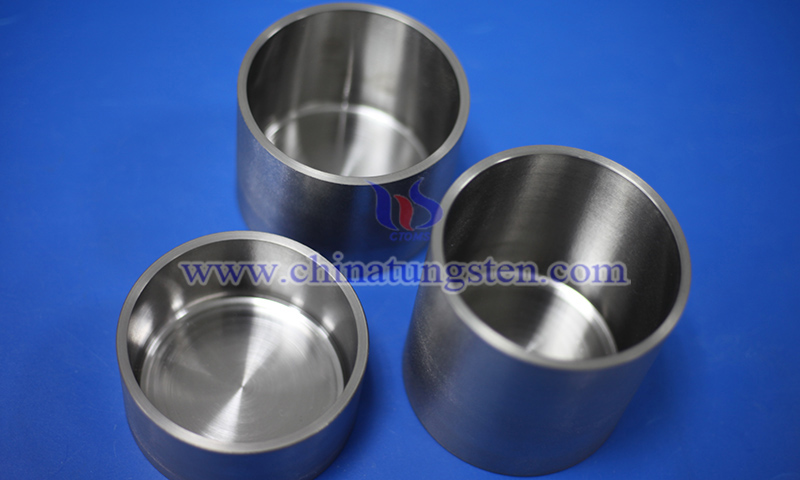
3. Role of Tungsten Crucible in Volatilization and Outgassing Control
In high-vacuum metallurgical environments of 10⁻⁴–10⁻⁶ Pa, material volatilization and outgassing behavior are highly sensitive factors.
Tungsten has extremely low vapor pressure and high recrystallization temperature (over 1,200°C), minimizing volatilization and structural instability at high temperatures, which helps maintain molten material purity. Its high thermal conductivity (~170 W/m·K) also improves thermal field uniformity, reducing thermal stress concentration caused by local temperature gradients.
4. How Does CTIA’s Tungsten Crucible Match Thermal Fields?
Different metal systems have varying requirements for temperature gradients, molten pool depth, and thermal stress distribution, so crucible structure must be designed to match the thermal field. Optimization of wall thickness distribution, reinforced bottom structures, and grain structure control are applied to improve high-temperature lifespan and cycling stability, adapting tungsten crucibles for long-cycle melting applications.
CTIA GROUP has over 30 years of experience in tungsten crucible manufacturing, serving rare earth metallurgy and high-temperature refractory metal melting industries. Extensive operational data and structural optimization experience enable customized solutions across sintering, forging, and spinning process routes. Cylindrical, tapered, thickened-bottom, and special-shaped crucible designs are supported to meet thermal field matching requirements of various high-temperature metallurgical systems.
For any inquiry, please contact tungsten crucible manufacturer: CTIA GROUP
Email: sales@chinatungsten.com
Tel: 0086 592 5129696 / 0086 592 5129595
Website: www.tungsten.com.cn
WeChat:

More info>>