
How to Choose Tungsten Electrode?
How to choose tungsten electrode? Tungsten electrodes are critical current-carrying components in Gas Tungsten Arc Welding (GTAW) and Plasma Arc Welding (PAW). Electrode grade, diameter, and tip geometry directly affect arc starting performance, arc stability, weld quality, and electrode service life. CTIA believes that different base metal, welding currents, and welding processes require different electrode characteristics. Therefore, proper electrode selection is essential for achieving stable welding quality and reducing overall operating costs.
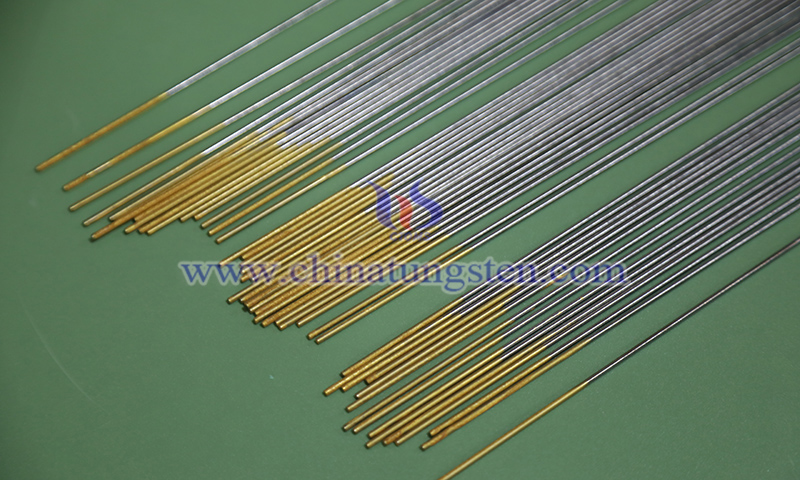
1. Choose the Right Tungsten Electrode Grade
(1) Pure Tungsten Electrode (WP)
CTIA’s pure tungsten electrodes typically contain no less than 99.9% tungsten and are mainly used for Alternating Current (AC) welding of aluminum, magnesium, and their alloys. They readily form a stable balled tip under AC conditions but offer relatively lower arc-starting performance and electron emission capability.
(2) Zirconiated Tungsten Electrode (WZ3, WZ8)
CTIA’s zirconiated tungsten electrodes contain 0.15–0.9% zirconium oxide (ZrO₂), providing excellent AC current-carrying capacity and contamination resistance. WZ8 is currently the most widely used zirconiated tungsten electrode grade and is suitable for high-current AC welding of aluminum, magnesium, and their alloys. It offers better arc stability and burn-off resistance than pure tungsten electrodes.
(3) Lanthanated Tungsten Electrode (WL10, WL15, WL20)
CTIA’s lanthanated tungsten electrodes contain 1.0–2.0% lanthanum oxide (La₂O₃), offering excellent arc-starting performance, arc stability, and long service life. Suitable for both AC and DC (Direct Current) welding, they have become one of the most widely used general-purpose tungsten electrode types.
(4) Ceriated Tungsten Electrode (WC20)
CTIA’s ceriated tungsten electrodes contain approximately 2.0% cerium oxide (CeO₂). They feature a low work function and excellent low-current arc-starting performance, making them suitable for thin-sheet welding, pipe welding, automated welding, and precision welding applications.
(5) Thoriated Tungsten Electrode (WT10, WT20, WT30, WT40)
CTIA’s thoriated tungsten electrodes contain 0.8–4.2% thorium oxide (ThO₂), providing excellent electron emission and high current-carrying capacity for high-current DC welding. WT20 red-tip tungsten electrode has traditionally been one of the most widely used grades. However, some applications have gradually shifted toward lanthanated and composite rare earth tungsten electrodes.
(6) Yttriated Tungsten Electrode (WY20)
CTIA’s yttriated tungsten electrodes contain approximately 2.0% yttrium oxide (Y₂O₃), offering excellent electron emission capability, high-temperature stability, and burn-off resistance. They are widely used in aerospace, nuclear industry, and high-precision automated welding applications.
(7) Composite Rare Earth Tungsten Electrode
CTIA’s composite rare earth tungsten electrodes incorporate two or more rare earth oxides to combine excellent arc-starting performance, arc stability, current-carrying capacity, and long service life. They are increasingly used in robotic welding, automated welding, and advanced manufacturing applications.
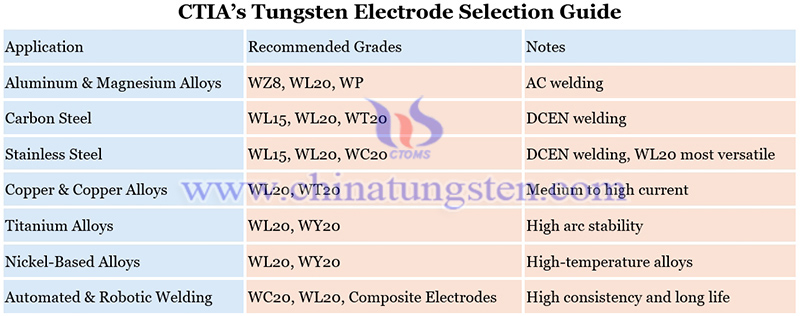
2. Select CTIA’s Tungsten Electrodes by Base Metal
CTIA’s tungsten electrode selection guide is shown in picture below:
3. Select CTIA’s Tungsten Electrode Diameter by Welding Current
Tungsten electrode diameter is closely related to welding current. Common selection guidelines are as follows:
(1) φ1.0 mm Electrode: 5–70 A
(2) φ1.6 mm Electrode: 50–150 A
(3) φ2.4 mm Electrode: 100–250 A
(4) φ3.2 mm Electrode: 200–350 A
(5) φ4.0 mm Electrode: 300–500 A
(6) φ4.8 mm Electrode: Above 400 A
Proper matching of current and electrode diameter helps prevent excessive burn-off, tip melting, and arc instability.
4. Select the Appropriate Tip Geometry
(1) Pointed Tip
Suitable for DC welding, providing concentrated arc energy, deeper penetration, and higher welding precision.
(2) Balled Tip
Mainly used for AC welding of aluminum and magnesium alloys, offering excellent arc stability and current-carrying capacity.
(3) Truncated Cone Tip
Suitable for automated and precision welding applications, balancing arc stability and electrode service life.
CTIA GROUP has over 30 years of experience in tungsten electrode manufacturing, offering pure tungsten, zirconiated, lanthanated, ceriated, thoriated, yttriated, and composite rare earth tungsten electrodes. Custom grades, diameters, and tip geometries are available to meet diverse welding requirements.
For any inquiry, please contact tungsten electrode manufacturer: CTIA GROUP
Email: sales@chinatungsten.com
Tel: 0086 592 5129696 / 0086 592 5129595
Website: www.tungsten.com.cn
WeChat:

More info>>