
Tungsten Electrode vs. Molybdenum Electrode
What are differences between tungsten electrode and molybdenum electrode? Tungsten electrode and molybdenum electrode are both typical refractory metal electrode, playing important roles in high-temperature conduction, electron emission, arc discharge, and vacuum environments. As two of the most widely used high-temperature electrode, tungsten and molybdenum differ significantly in melting point, high-temperature strength, thermionic emission capability, arc erosion resistance, and application conditions.
Tungsten electrode, with an ultra-high melting point of 3422°C and excellent electron emission performance, is widely used in Tungsten Inert Gas (TIG) welding, plasma welding, electron beam systems, and semiconductor equipment. Molybdenum electrode, with good electrical conductivity and excellent corrosion resistance in glass melts, is widely used in glass melting, electric heating systems, and vacuum furnaces. A clear understanding of their performance differences helps select the most suitable electrode material based on operating conditions and equipment requirements.
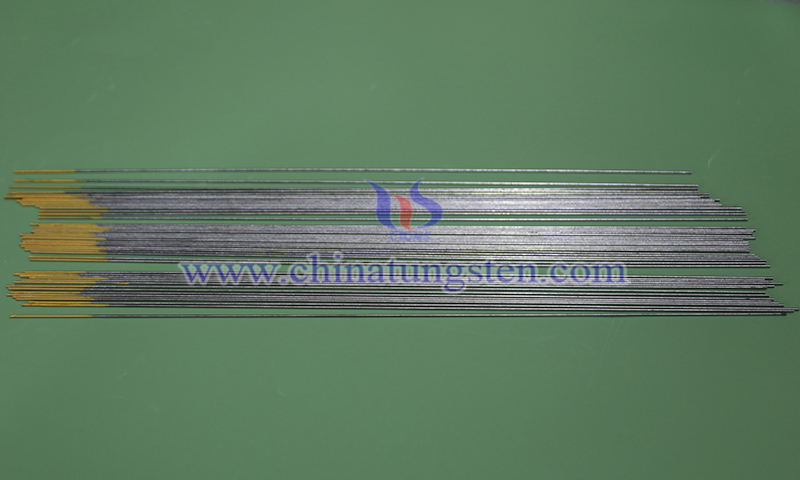
1. Key Differences Between CTIA’s Tungsten Electrode and Molybdenum Electrode
(1) Differences in Melting Point and High-Temperature Resistance
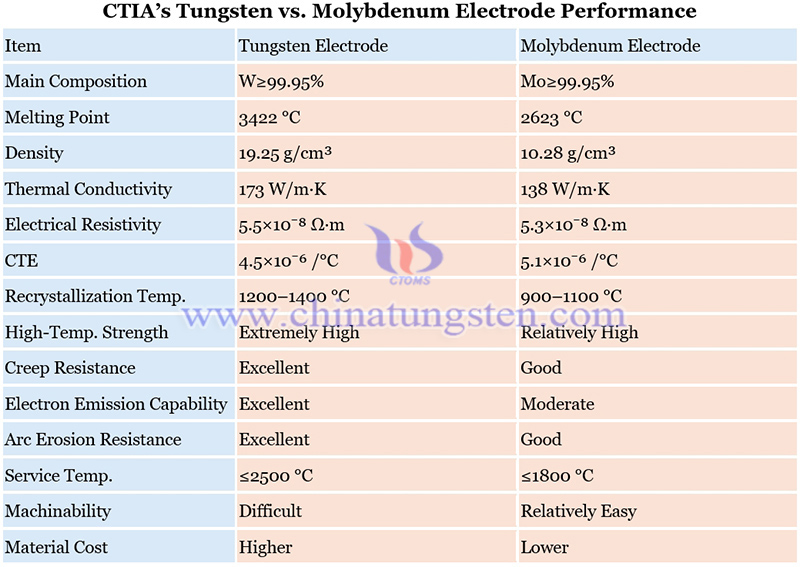
Melting point is a key indicator of high-temperature capability. Tungsten has a melting point of 3422°C, one of the highest among pure metals, while molybdenum has a melting point of 2623°C. Under ultra-high temperature conditions, tungsten electrode maintains better dimensional stability and structural strength. In electron beam systems, plasma equipment, vacuum thermal fields, and high-temperature discharge devices, tungsten electrode generally provides a longer service life.
(2) Differences in High-Temperature Strength and Creep Resistance
With increasing temperature, materials may undergo creep deformation. Tungsten has a higher recrystallization temperature and stronger high-temperature strength, maintaining structural stability even above 2000°C. Molybdenum is more prone to deformation under long-term high-temperature exposure and is therefore more suitable for relatively lower-temperature environments.
(3) Differences in Electron Emission Performance
Electron emission capability is critical for electron guns, vacuum devices, and welding electrodes. Tungsten exhibits excellent thermionic emission performance, which can be further improved by doping with lanthanum, cerium, or thorium oxides. It is widely used in TIG welding, plasma welding, and electron beam equipment. Molybdenum has good conductivity but lower thermionic emission capability, making it less suitable for high-energy electron emission applications.
(4) Differences in Thermal Conductivity and Heat Dissipation
Both materials have good thermal conductivity. Tungsten has a thermal conductivity of about 173 W/m·K, slightly higher than molybdenum at 138 W/m·K. Under high-power discharge and continuous heating conditions, tungsten electrode transfers heat more efficiently, reducing local overheating.
(5) Differences in Application
Tungsten electrode is mainly used in TIG welding, plasma welding and cutting, semiconductor manufacturing, electron beam systems, ion sources, EDM (Electrical Discharge Machining) applications, and vacuum electronic devices. Molybdenum electrode is mainly used in glass melting, glass fiber production, rare earth smelting, vacuum furnace heating components, high-temperature electric heating, and molten metal conduction systems. The glass industry is the most typical application field for molybdenum electrode.
2. Performance Comparison of CTIA’s Tungsten Electrode and Molybdenum Electrode
The performance comparison of CTIA’s tungsten electrode and molybdenum electrode is shown in the picture below:
3. How to Choose Between Tungsten Electrode and Molybdenum Electrode?
Based on extensive industrial applications, CTIA finds that tungsten electrode is more suitable for environments involving high-temperature arcs, high-energy electron emission, high-power discharge, or long-term operation above 1800°C. Molybdenum electrode is more suitable for glass melting, high-temperature conductive heating, and medium-to-high temperature environments where cost efficiency and machinability are important. For semiconductor equipment, electron beam systems, vacuum furnace thermal fields, and high-end welding applications, tungsten electrode is generally the preferred solution.
With over 30 years of tungsten electrode manufacturing experience, CTIA GROUP specializes in the full production chain from high-purity tungsten powder preparation to precision grinding. A full range of products is available, including pure tungsten electrodes, lanthanated tungsten electrodes, ceriated tungsten electrodes, zirconiated tungsten electrodes, thoriated tungsten electrodes, yttriated tungsten electrodes, composite tungsten electrodes, and special-shaped tungsten electrodes. CTIA provides customized solutions for electron beam, semiconductor, vacuum electronics, plasma, and TIG welding applications, ensuring stable arc ignition, longer service life, and reliable high-temperature performance.
For any inquiry, please contact tungsten electrode manufacturer: CTIA GROUP
Email: sales@chinatungsten.com
Tel: 0086 592 5129696 / 0086 592 5129595
Website: www.tungsten.com.cn
WeChat:

More info>>