
How to Identify Quality of Tungsten Electrode?
How to identify the quality of tungsten electrode? Tungsten electrodes are critical in Gas Tungsten Arc Welding (GTAW) and Plasma Arc Welding (PAW). Their quality directly affects arc starting performance, arc stability, weld quality, and electrode service life. Differences in raw material purity, rare earth doping technology, material density, and manufacturing precision can significantly influence electrode performance. Therefore, tungsten electrode quality should be evaluated from multiple aspects, including surface condition, material properties, microstructure, and welding performance.
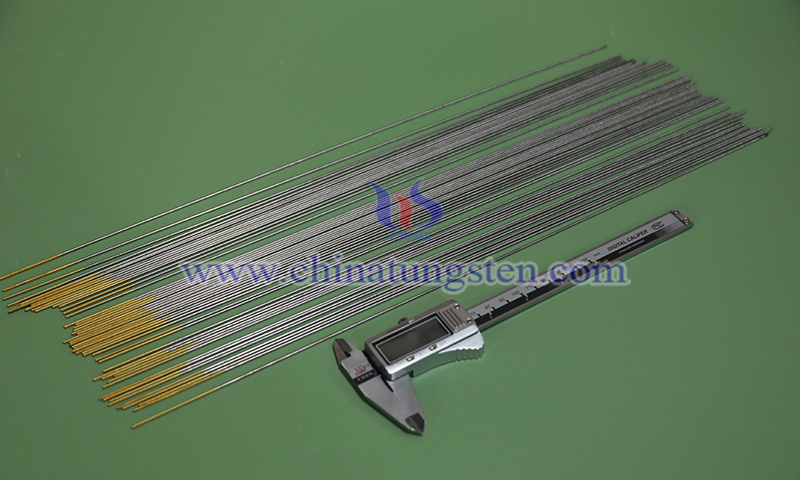
1. Check the Surface Quality of Tungsten Electrodes
(1) Surface Finish
High-quality tungsten electrodes should have a smooth and uniform surface free from cracks, scratches, oxidation spots, dents, or mechanical damage. Surface defects may cause localized overheating and abnormal erosion.
(2) Dimensional Accuracy
Electrode diameter and length should comply with applicable standards. Diameter tolerances are typically controlled within ±0.02 mm. Better dimensional consistency contributes to more stable welding performance.
(3) Color Identification
Different tungsten electrode grades should have clear and uniform color markings. Blurred, damaged, or inconsistent color codes may affect grade identification and proper electrode selection.
2. Evaluate Material Purity and Microstructure
(1) Tungsten Content
High-quality pure tungsten electrodes typically contain no less than 99.9% tungsten. For lanthanated, ceriated, and zirconiated tungsten electrodes, rare earth additives should be uniformly distributed to ensure stable electron emission.
(2) Structural Uniformity
Premium tungsten electrodes manufactured through powder metallurgy technology should exhibit a dense and uniform grain structure. Non-uniform microstructures may lead to uneven erosion, cracking, or reduced service life.
(3) Density Level
High-quality tungsten electrodes typically achieve a relative density exceeding 95% of theoretical density. Higher density improves electrical conductivity and high-temperature performance.
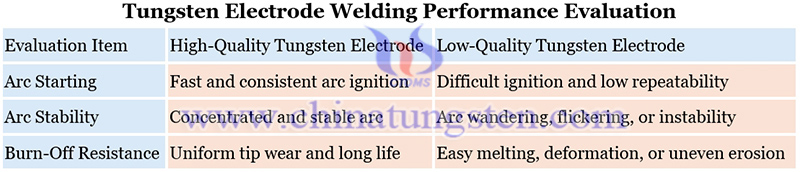
3. Evaluate Welding Performance
The welding performance evaluation guide of tungsten electrode is shown in picture below:
4. Inspect Electrode Condition After Use
(1) Tip Wear Condition
High-quality tungsten electrodes wear evenly and maintain a consistent tip shape. Lower-quality products are more likely to experience uneven erosion, cracking, or abnormal melting.
(2) Contamination Resistance
Premium tungsten electrodes are less likely to absorb impurities from the weld pool and can maintain stable electron emission over extended periods.
(3) Service Life
Under identical welding conditions, high-quality tungsten electrodes generally provide longer operating life and require less frequent replacement.
Long-term industrial applications from CTIA GROUP have demonstrated that high-quality tungsten electrodes feature uniform microstructures, stable electron emission, excellent burn-off resistance, and extended service life, helping improve welding quality and production efficiency. With more than 30 years of manufacturing experience, CTIA supplies pure tungsten, lanthanated, ceriated, zirconiated, yttriated, and composite rare earth tungsten electrodes, with custom specifications available for diverse welding applications.
For any inquiry, please contact tungsten electrode manufacturer: CTIA GROUP
Email: sales@chinatungsten.com
Tel: 0086 592 5129696 / 0086 592 5129595
Website: www.tungsten.com.cn
WeChat:

More info>>